
Bedding for Airbnb hosts: practical buying guide
Choose durable, white, hospitality-grade bedding and keep a minimum three-set par per bed. That single rule covers most hosting scenarios and is backed by AirDNA’s short-term rental analysis, host-tested practice across UK properties, and Roomie Design’s curated host bundles. The bed is the most photographed and most reviewed element of any listing. Getting it right is an operational decision, not a decorating one.
Table of Contents
- What bedding does every Airbnb need?
- How to choose bedding for an Airbnb
- Which materials work best for UK rental properties?
- What tog rating should you use for UK guests?
- Laundering, stain management and expected lifespan
- How many sets do you need and what should they cost?
- How to style a bed for listing photos and guest comfort
- Roomie Design recommended sets for UK hosts
- Why hotel-white bedding and host-tested choices work
- Hypoallergenic and allergy-friendly bedding options
- Recommended bedding sizes for UK Airbnb mattresses
- What actually makes the biggest difference for hosts
- Roomie Design host bundles: premium bedding, ready to order
- Sources
What bedding does every Airbnb need?
A quick pre-turnover checklist keeps stock consistent and prevents last-minute gaps.
- Mattress protector — waterproof, fitted, machine-washable at 60°C
- Fitted sheet — white, 100% cotton or linen, correct size for mattress depth
- Flat sheet (optional for triple-sheeting) — same material and colour as fitted
- Duvet inner — 10.5 tog baseline; store a 4.5 tog lightweight for summer
- Duvet cover — white or neutral, easy-care fabric, full zip or button closure
- Pillows — two per guest; include at least one firm and one medium option
- Pillow protectors — waterproof inner protectors under every pillowcase
- Spare sets — minimum three complete sets per bed
- Throw — one per bed for styling and extra warmth
- Sleeping mask — optional but appreciated; low cost, high guest satisfaction
The three-set par rule comes from a practical operational reality: one set on the bed, one in the laundry, one clean and ready. Cotton House confirms that three sets per bed is the standard minimum, with busier or multi-room properties needing four or five. Running below par risks a delayed turnover if a wash cycle overruns.
Pro Tip: After every turnover, hold each pillowcase up to the light before folding. Fading, thinning fabric, or yellowing at the seams means it is due for replacement — catching this before a guest does protects your review score.
How to choose bedding for an Airbnb
Before buying, run through four quick questions.
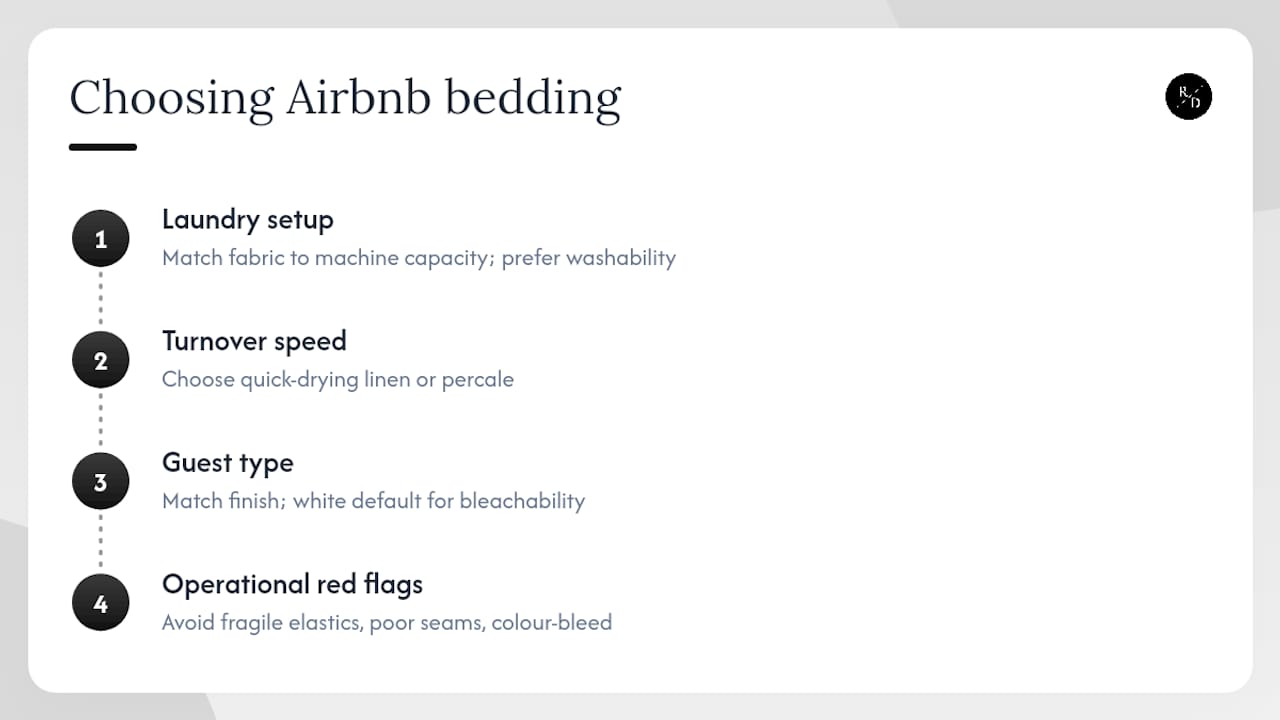
What is your laundry setup? A domestic washing machine handles a double duvet cover and two sheets per cycle. If you are managing multiple rooms, a commercial laundry service or a larger-capacity machine changes which fabrics are practical.
How fast is your turnover? Same-day turnovers with a professional cleaner demand fabrics that dry quickly. Linen and percale cotton dry faster than sateen or high-pile microfibre. If your cleaner is working to a two-hour window, drying time matters as much as softness.
Who are your guests? City lets attract business travellers who expect hotel-clean simplicity. Family holiday homes need robust, stain-resistant fabrics that survive children. Luxury boutique listings can justify premium finishes and higher thread counts.
What are the operational red flags? Avoid bedding with fragile elastics on fitted sheets (they fail within 20 washes), poor stitch quality at pillowcase seams, and any fabric that bleeds colour in a hot wash. White is the practical default because it can be washed at 60°C, bleached when needed, and replaced piece by piece without mismatching.
Prioritise durability and washability first. Softness and finish are secondary. A guest who sleeps on crisp, clean, white sheets will rate the bed well. A guest who notices a stain or a pilling duvet cover will not.
Which materials work best for UK rental properties?
The right fabric depends on your hosting scenario. Here is a plain-language breakdown.
- Cotton percale — crisp, cool, fast-drying. Suits city lets and high-turnover properties. Linen Plus notes that percale weaves combine breathability with durability, making them a reliable choice for frequent laundering.
- Cotton sateen — silky, smooth, slightly heavier. Slower to dry than percale but delivers a noticeably luxurious feel. Suits boutique or lower-turnover listings.
- 100% linen — highly breathable, softens with every wash, naturally temperature-regulating. Ideal for coastal cottages and summer lets. The Natural 100% Linen Bedding Set from Roomie Design suits hosts who want a relaxed, premium aesthetic.
- Cotton-poly blend — shrink-resistant, fast-drying, lower cost per wash. Practical for budget-conscious hosts managing multiple rooms.
- Lyocell (Tencel) — soft, moisture-wicking, gentle on sensitive skin. Good for allergy-aware listings.
- Microfibre — affordable and quick-drying, though it can pill faster than natural fibres under heavy use.
Thread count and premium options. For hosts choosing cotton, thread counts in the 400–1000 TC range deliver a noticeably richer, softer hand feel. Higher thread count sheets carry more yarn per square inch, which translates to a denser, more sumptuous surface that guests associate with hotel-quality comfort. The Aristocrat Gold Luxury Bedding Set and the Nocturne Jacquard Luxury Bedding Set both sit in this premium tier, offering durability alongside a refined finish that photographs beautifully. For a softer, more decorative option, the Isabella Luxury Bedding Set works well in boutique and luxury listings. See Roomie Design’s premium bedding materials guide for a full material comparison.
What tog rating should you use for UK guests?
UK weather varies enough that a single duvet rarely satisfies all guests year-round. Cool Linen recommends a 10.5 tog as the all-round baseline for most rentals, with a lightweight option available for warmer months.
A practical three-option approach:
- 4.5 tog — summer months (May–September), warm properties, or guests who run hot
- 10.5 tog — spring and autumn; the default for most UK listings
- 13.5–15 tog — winter lets, unheated cottages, or properties in Scotland and northern England
For hosts who want simplicity, an all-season duvet (two layers that clip together to form a 10.5 tog or higher) covers most scenarios with one product. Store the lighter layer separately in a labelled bag so cleaners can swap easily.
Presenting options to guests. A short note in the welcome manual works well: “A 10.5 tog duvet is on the bed. A lighter 4.5 tog is in the wardrobe if you prefer. Extra blankets are in the ottoman.” That one sentence removes the most common temperature complaint before it reaches a review.
For coastal or seasonal holiday properties, store heavier duvets in vacuum bags between seasons. This protects them from damp and keeps the wardrobe clear. Linen Plus also recommends washable duvet covers so the layer touching guests is laundered every stay, even when the inner is not washed as frequently.
Laundering, stain management and expected lifespan
Consistent laundering is the single biggest factor in how long rental bedding lasts.
Cotton House’s hospitality data shows retail sheets typically last around 80 washes, while commercial-grade equivalents can reach 300 or more. At two washes per week for a busy property, retail sheets may need replacing within a year. Hospitality-grade sets stretch that to two or three years, which changes the cost-per-wash calculation significantly.
Stain management. Treat stains before washing, not after. Cold water and a small amount of washing-up liquid handles most organic stains (blood, food, wine). For stubborn marks, a pre-soak in an oxygen-based stain remover at 40°C before the main wash is effective on white cotton. Never use chlorine bleach on linen or lyocell.
When to retire bedding. Inspect each item at the fold: pilling on the surface, thinning at the seams, elastic that no longer grips, or any permanent discolouration means it is time to replace. A professional rental property cleaning checklist can help cleaners flag worn items during turnover without relying on the host to inspect in person.
How many sets do you need and what should they cost?
Par levels and budget planning go together. Under-stocking creates turnover delays; over-buying ties up cash unnecessarily.
| Property type | Minimum sets per bed | Recommended sets |
|---|---|---|
| Single room, low turnover | 3 | 3–4 |
| Single room, high turnover | 3 | 4–5 |
| Multi-room (3+ beds) | 3 per bed | 4 per bed |
| Luxury listing | 3 | 4–5 (matching sets) |
Budget ranges (UK, per complete set including duvet cover, two pillowcases, fitted sheet):
- Entry level (£20–£45): Cotton-poly or microfibre. Acceptable for budget listings; replace more frequently.
- Mid range (£45–£90): 100% cotton percale or sateen, 200–400 TC. Good durability, fast-drying, guest-pleasing.
- Premium (£90–£200+): High thread count cotton (400–1000 TC), linen, lyocell, or luxury jacquard. Lower cost-per-wash over time; stronger guest impression.
The Linen Factory highlights that bulk and case ordering helps hosts maintain consistent stock across multiple properties, often at better unit pricing. If you manage three or more listings, buying matching sets in bulk reduces per-unit cost and keeps the guest experience uniform.
Phasing upgrades. Replace one room at a time rather than all at once. Start with the bedroom that generates the most bookings or the highest nightly rate. Once that room is performing well in reviews, reinvest the revenue uplift into the next room.
How to style a bed for listing photos and guest comfort
White bedding is the starting point. Hospitality designers consistently report that white linens act as a cleanliness cue, lifting first impressions in listing photos and in person. A white base also means individual pieces can be replaced without mismatching.
Photo-ready styling in four steps:
- Start with a smooth, tight fitted sheet — no visible creases at the corners.
- Fold the duvet cover back by 30 cm at the top to show the pillows and create depth.
- Stack two pillows per side, with sleeping pillows behind and decorative cushions in front if used.
- Lay a single throw across the foot of the bed, folded in thirds lengthways.
That setup photographs cleanly, takes under three minutes to replicate, and requires no specialist styling. For more ideas on creating a high-end look without increasing cleaning overhead, Roomie Design’s guide on making a room look expensive covers practical styling principles that translate directly to listing photography.
What to avoid. Decorative cushions with piping or embellishment collect lint and take longer to arrange. Faux-fur throws shed and are difficult to launder. Coloured or patterned bedding that does not match the room’s palette reads as cluttered in photos. Keep it simple: white base, one neutral throw, symmetrical pillows.
Roomie Design recommended sets for UK hosts
Different hosting scenarios call for different products. Here are the clearest matches.
City let or high-turnover property. The White 100% Linen Bedding Set delivers a hotel-clean look with natural breathability. Linen softens with every wash, dries quickly, and holds its shape across hundreds of laundry cycles. It suits guests who expect a premium finish without fuss.
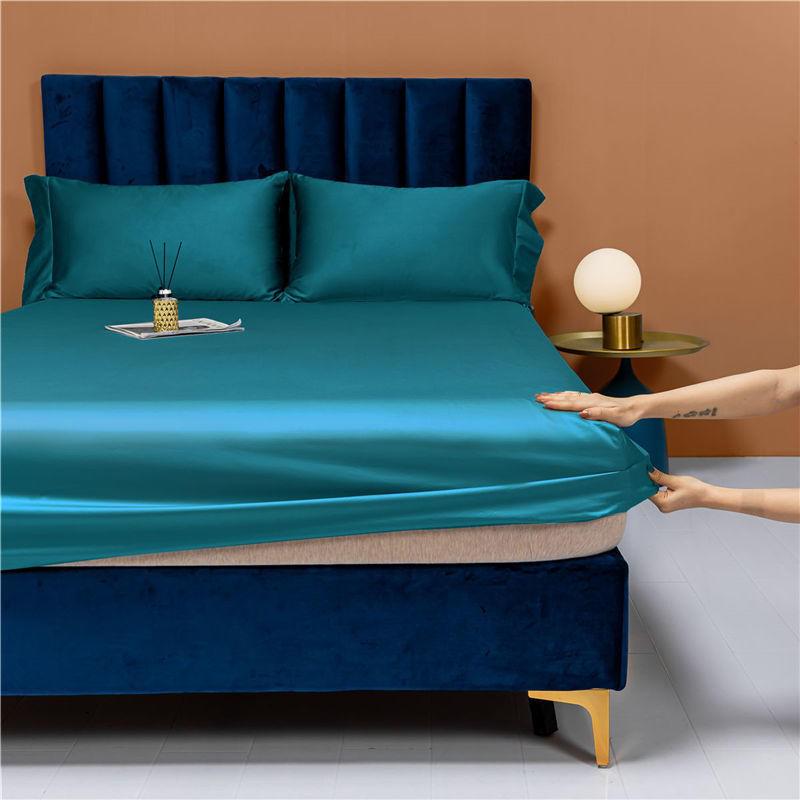
Luxury boutique listing. The Nocturne Jacquard Luxury Bedding Set and the Aristocrat Gold Luxury Bedding Set both photograph exceptionally well and signal a considered, high-end aesthetic. These are the sets that generate the “loved the bedding” comments in reviews.
Family holiday home. The Isabella Luxury Bedding Set offers a softer, more welcoming finish that suits family-oriented properties. Pair it with hypo-allergenic down alternative pillows to cover allergy-sensitive guests without maintaining separate sets.
Coastal or relaxed-aesthetic property. The Natural 100% Linen Bedding Set suits properties where the aesthetic leans towards natural textures. The Natural Flax Linen Sheet is useful for building bespoke par sets or replacing individual worn pieces.
Before adding to cart, check:
- Mattress depth (standard UK mattresses are 25–35 cm; extra-deep fitted sheets are needed above 30 cm)
- Size (UK double, king, super king — not EU or US sizing)
- Quantity needed to reach par level (minimum three sets per bed)
- Returns policy for bulk orders
Host forums on r/AirBnBHosts consistently flag pillow variety and mattress protection as the two highest-impact improvements for 5-star reviews. Stocking both a firm and a medium pillow per bed, and fitting a quality mattress protector, addresses both points at low cost.
Why hotel-white bedding and host-tested choices work
The evidence for white, hospitality-grade bedding is consistent across market analysis and host practice. AirDNA’s rental market analysis links bedding quality directly to guest satisfaction scores and listing performance. The bed is the most reviewed element of a stay; it is also the most photographed in listing images.
Host insight: White bedding signals that everything has been freshly laundered. Guests cannot see a thread count, but they can see whether the sheets are bright, smooth, and free of stains. That visual cue does more for a review score than any decorative detail.
The cost-per-wash logic reinforces the case for premium. A mid-range cotton set at £60 lasting 100 washes costs £0.60 per wash. A hospitality-grade set at £120 lasting 300 washes costs £0.40 per wash. Over two years of weekly laundering, the premium set is cheaper. Hercleon’s hygiene research confirms that guests hold high hygiene expectations and that visible cleanliness, including bright, well-maintained bedding, directly increases guest confidence.
Hypoallergenic and allergy-friendly bedding options
Allergy-aware guests are a growing segment of the short-term rental market. Providing hypoallergenic bedding is a practical differentiator that can be mentioned in your listing description.
Key choices for allergy-sensitive guests:
- Down alternative pillows — synthetic fills mimic the softness of down without triggering feather allergies. Roomie Design’s hypo-allergenic down alternative pillows are machine-washable and straightforward to maintain.
- Lyocell (Tencel) sheets — moisture-wicking and less hospitable to dust mites than synthetic fabrics. A good choice for guests with skin sensitivities.
- Linen bedding — naturally breathable and temperature-regulating; linen’s open weave resists moisture build-up, which reduces the conditions dust mites prefer.
- Pillow and mattress protectors — waterproof, dust-mite-barrier protectors under every pillow and on every mattress are the single most effective allergy-control measure. Wash at 60°C between every stay.
Mention allergy-friendly bedding in your listing. A short line such as “hypoallergenic pillows and dust-mite-barrier protectors provided” costs nothing to add and can be the deciding factor for a guest choosing between two similar properties.
Recommended bedding sizes for UK Airbnb mattresses
UK bed sizing differs from European and US standards. Using the wrong size creates loose fitted sheets and oversized duvet covers, both of which look untidy in photos and feel uncomfortable to guests.
Always measure mattress depth before ordering fitted sheets. UK mattresses commonly run 25–35 cm deep; platform beds with toppers can exceed 40 cm. A fitted sheet labelled “standard depth” (25 cm) will not stay on a 35 cm mattress. Check the product’s stated pocket depth, not just the surface dimensions.
Roomie Design’s size guide covers all standard UK sizes and includes guidance on matching duvet covers to mattress dimensions. If your property has a non-standard mattress (a zip-and-link king, for example), measure both halves separately before ordering.
What actually makes the biggest difference for hosts
The conventional advice on Airbnb bedding focuses on aesthetics: white sheets, hotel folds, decorative cushions. That framing is not wrong, but it misses the operational half of the picture.
The hosts who consistently earn 5-star bed reviews are not necessarily the ones with the most expensive sets. They are the ones who have solved the logistics: three sets per bed so a late checkout never delays a turnover, pillow protectors that get washed every stay so nothing is ever visibly stained, and a mattress protector that means the mattress itself never needs replacing early.
The small investments that return the most are predictable. A quality mattress protector at £25–£40 extends a mattress’s usable life by years. Stocking one firm and one medium pillow per guest position removes the most common comfort complaint. A labelled storage system for spare sets means a cleaner can turn over a room without waiting for the host to confirm what goes where.
Premium bedding matters. But premium bedding without the operational structure around it still produces inconsistent results. Get the par levels right, get the protectors on, and then invest in the finish.
Roomie Design host bundles: premium bedding, ready to order
Roomie Design stocks the full range UK hosts need, from hotel-white linen sets to luxury jacquard duvet covers, all available in standard UK sizes with a clear size guide and customer reviews to guide selection.
Whether you are stocking a single city let or a multi-room holiday home, Roomie Design’s range covers every scenario: breathable linen for coastal properties, high thread count cotton for boutique listings, and hypoallergenic options for allergy-aware guests. Premium materials, straightforward returns, and multi-currency checkout make it practical for UK hosts ordering in bulk or building par sets one room at a time.
Browse the full host range and check sizing at Roomie-design and order the sets you need to reach your par level today.
Sources
- How to Choose the Best Bedding for Airbnb or Vacation Rental
- Best Bedding Solutions for Airbnb & Short-Term Rentals - Cotton House
- Airbnb Bedding Idea — Linen Plus
- A No Brainer List: The Best Bedding and Mattress for your Airbnb - Quill Decor
- Best Duvets for Airbnb & Holiday Rentals - Cool Linen Ltd
- The Signature Collection- Curated Bedding Collection - The Linen Factory
- How Hygienic are Hotel and Airbnb Towels and Should You Carry Your Own - Hercleon


