
Travel-friendly bedding solutions for frequent travellers
The best travel-friendly bedding solutions share three qualities: they pack small, feel familiar, and keep you comfortable regardless of where you sleep. Whether you are on a long-haul flight, checking into a city hotel, or setting up a tent at a campsite, the right portable bedding options reduce the friction between a strange environment and a genuinely restorative night’s sleep. The key elements worth prioritising are:
- Lightweight, compact sheets that add minimal weight to your luggage, with silk travel sheets weighing as little as 159g
- Breathable, durable fabrics such as silk, Pima cotton, and microfibre, each suited to different climates and washing conditions
- Pillow compartments and secure closures to keep bedding aligned and pillows in place through the night
- Temperature management layers that can add approximately 3 degrees of warmth when used as a liner inside a sleeping bag
- Consistent bedding routines that anchor your circadian rhythm and reduce the disorientation of sleeping in unfamiliar places
What makes the best bedding surface for frequent travellers?
The sleeping surface you bring with you sets the ceiling on your sleep quality. A poor surface undermines even the finest sheets.
Tri-fold memory foam mattresses outperform roll-up types because they lie flat, stack compactly, and hold their shape. High-density foam prevents the mattress from bottoming out under body weight, which is the most common complaint with budget travel mattresses. The result is support closer to a home bed than most portable options manage.
Key features to look for in a travel mattress:
- Removable, machine-washable cover for hygiene during extended trips
- Tri-fold design for flat, stable sleeping and compact storage
- High-density foam core to prevent compression and maintain support
- Storage bag included so the mattress packs neatly into luggage or a car boot
- Dimensions that suit your height — check folded size before purchasing
For travellers who do not need a full mattress, a compact folding mattress topper placed over a hotel bed or hostel bunk can meaningfully improve comfort without the bulk.
How do you manage temperature and breathability in travel bedding?
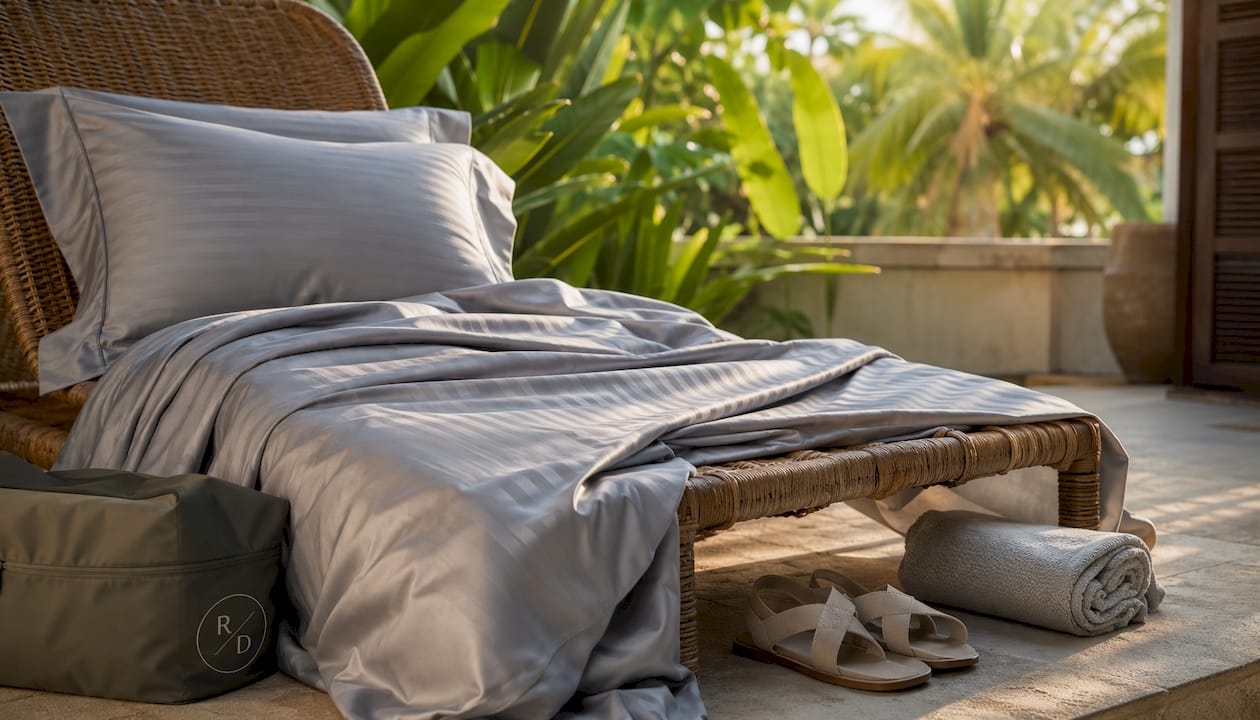
Fabric choice is the single biggest lever for temperature control on the road. Get it right and you sleep well in Bangkok and Bergen alike.
Silk leads for packability and thermal adaptability. It dries faster than cotton and regulates temperature naturally, making it the top choice for minimalist packers moving between climates. Pima cotton and Egyptian cotton offer a different balance: longer fibres produce a finer, more breathable weave that wicks moisture and holds up to repeated washing. For humid destinations, microfibre and Coolmax fabrics dry quickly and resist the clamminess that plagues heavier materials.
- Silk: lightest option, fastest drying, adapts to both warm and cold climates
- Pima and Egyptian cotton: durable, breathable, moisture-wicking, good for frequent washing
- Microfibre (100% polyester): fast-drying, soft grip, suited to hot and humid conditions
- Brushed cotton: soft against skin, regulates body heat, adds warmth as a liner
- Ripstop silk: grid-woven for tear resistance, combines silk’s thermal properties with greater durability
Used as a liner inside a sleeping bag, a travel sheet adds warmth and keeps the bag itself fresh across multiple trips.
Which travel pillows actually keep you comfortable?
Pillow discomfort is one of the most underestimated causes of poor sleep during travel. A pillow that shifts in the night, or one that feels nothing like what you use at home, disrupts sleep continuity.
A dedicated pillow compartment in a travel sheet is the most practical solution. It holds a standard-sized pillow securely so it does not migrate during the night, and it lets you use your own pillow rather than relying on whatever the accommodation provides. That tactile familiarity matters more than most travellers expect.
Practical pillow considerations for travel:
- Pillow pocket in travel sheet: keeps your pillow in place and covered by familiar fabric
- Compressible travel pillows: pack small and recover their shape quickly
- Improvised inserts: a bundled jacket or fleece works in a pinch when packed into a pillow compartment
- Hygiene: a pillow cover that is easy to remove and wash keeps things fresh on longer trips
- Familiar fabric: bringing a pillowcase from home costs almost nothing in weight and significantly improves sleep quality
Pro Tip: Pack a single pillowcase from your own bed. The familiar texture and scent are more effective at easing you into sleep in a strange room than almost any other single item.
How can you create a better sleep environment while travelling?
The environment around your bedding matters as much as the bedding itself. Darkness and quiet are the two variables most within your control, even in a noisy hotel or a shared hostel dormitory.
A quality sleeping mask blocks ambient light from street lamps, corridor gaps, and early-morning sun, which is particularly useful when crossing time zones. Paired with foam earplugs or noise-cancelling earphones, it replicates the sensory conditions of your bedroom at home. Layering your bedding to suit the room temperature, rather than relying on the accommodation’s fixed thermostat, gives you direct control over comfort.
- Sleep mask: blocks light from any source; particularly useful for east-facing hotel rooms at dawn
- Earplugs or noise-cancelling earphones: reduce ambient noise without requiring a quiet room
- Personal bedding layers: a familiar sheet or light blanket maintains sensory consistency
- Blackout curtain clips: lightweight clips that hold curtains shut are a low-cost, high-impact addition
- Temperature layering: use your travel sheet as a top layer or liner depending on room warmth
Why does consistent bedding improve recovery during travel?
Sleep consistency is not just about comfort. It directly affects how well your body recovers between travel days.
Familiar tactile sensations, the weight and texture of your own bedding, help anchor your circadian rhythm when your schedule is disrupted. This is why the “first-night effect,” the well-documented tendency to sleep poorly in a new environment, is noticeably reduced when travellers bring personal bedding items. Clean, freshly laundered bedding also provides a psychological sense of control that is particularly valuable in shared or unfamiliar accommodation. You can read more about the psychological benefits of personal bedding and how consistency supports sleep quality.
- Circadian anchoring: familiar bedding cues the brain that it is time to sleep, regardless of location
- First-night effect reduction: personal sheets and pillowcases reduce the disorientation of new environments
- Psychological comfort: clean, known bedding provides a sense of control in unpredictable settings
- Physical recovery: better sleep quality translates directly to sharper performance the following day
- Routine as a signal: a consistent pre-sleep bedding routine reinforces sleep onset even when travelling
For guidance on maintaining bedding hygiene in hotels and rentals, the short-term rental cleaning guide from The Maid Society covers what to look for and how to maintain standards on the road.
What materials do experts recommend for travel bedding?
Material selection is where the difference between a good and a poor travel bedding kit is decided. The right fabric handles washing, packing, and variable climates without compromise.
Silk remains the top recommendation for minimalist travellers. Its packability and rapid drying make it practical in destinations where laundry facilities are limited, and its natural temperature regulation suits both tropical and alpine conditions. For travellers who want more durability, ripstop silk incorporates a hexagonal grid of stronger threads that resist tearing without sacrificing the lightweight luxury of standard silk.
For the sleeping surface, high-density tri-fold memory foam with a machine-washable cover is the expert consensus for portable support. The washable cover is not optional for longer trips; it is the feature that keeps the mattress hygienic across weeks of use.
Pro Tip: Choose your travel sheet fabric based on your most common destination climate. Silk for variable or cold climates, microfibre for hot and humid, and Pima cotton for a versatile middle ground that handles frequent washing well.
- Silk: superior packability, natural temperature regulation, rapid drying
- Ripstop silk: tear-resistant grid weave, durable luxury for technical travellers
- Pima and Egyptian cotton: long-fibre weave, lightweight, durable, moisture-wicking
- High-density tri-fold foam: firm, stable, washable cover, prevents compression
- Microfibre: fast-drying, soft, suited to humid climates
How do travel bedding costs compare across budget levels?
Travel bedding spans a wide price range, and the right level of investment depends on how frequently you travel and what you prioritise.
At the entry level, basic cotton or microfibre travel sheets are widely available and handle occasional trips well. They wash easily and pack reasonably small, though they tend to be heavier than premium alternatives. Mid-range options in Pima cotton or standard silk offer a meaningful step up in packability and comfort without a significant price premium over basic cotton.
Premium silk and ripstop silk travel sheets represent the highest per-item cost but the lowest cost per use for frequent travellers, given their durability and performance across varied climates. A tri-fold memory foam mattress is a larger upfront investment, but for travellers who regularly stay in accommodation with poor beds, it pays back quickly in sleep quality.
| Budget level | Typical materials | Best suited to |
|---|---|---|
| Entry | Standard cotton, microfibre | Occasional travellers, short trips |
| Mid-range | Pima cotton, standard silk | Regular travellers, varied climates |
| Premium | Ripstop silk, high-density foam | Frequent travellers, extended trips |
Packing efficiently also reduces costs indirectly. Folding sheets flat and stacking tightly minimises luggage space, which can mean avoiding checked baggage fees on shorter trips.
Which bedding solutions work across planes, cars, hotels, and camping?
No single product covers every travel environment equally well, but a compact travel sheet comes closest to a universal solution.
On planes, a lightweight silk or microfibre travel sheet doubles as a blanket and provides a clean layer over airline-provided pillows. In cars, a compact folding mattress in the boot transforms a vehicle into a viable sleeping space for road trips or festival camping. Hotel stays benefit most from a personal travel sheet that creates a familiar layer over provided bedding, particularly useful when linen quality is uncertain. For camping, a travel sheet used as a liner inside a lightweight sleeping bag adds warmth and keeps the bag fresh between washes.
- Planes: silk or microfibre travel sheet as a blanket and clean pillow cover
- Cars: tri-fold mattress in the boot for road trips and overnight stops
- Hotels: personal travel sheet over provided linen for hygiene and familiarity
- Camping: travel sheet as a sleeping bag liner for added warmth and hygiene
- Hostels: travel sheet as a protective barrier over shared bedding
The hotel bedding standards guide from Roomie Design covers how to replicate home sleep quality in hotel environments, which is directly relevant for frequent business travellers.
A practical perspective on travel bedding that actually works
The conventional advice on travel bedding focuses almost entirely on weight and pack size. Those matter, but they are not the whole picture. The travellers who sleep best on the road are the ones who have thought about tactile consistency, not just grams.
Bringing a pillowcase from home costs nothing in meaningful luggage weight. A tri-fold mattress is a larger commitment, but for anyone who travels more than a few times a year to destinations with variable bed quality, it removes the single biggest variable in sleep quality. Fabric breathability matters most when you are travelling to climates that differ significantly from home. A silk or Pima cotton sheet that packs to the size of a paperback handles that range better than any synthetic alternative.
Machine-washable components are not a luxury feature. On any trip longer than a week, the ability to wash and dry your bedding quickly is what keeps the whole system working. Clean bedding is also the factor that most directly affects how rested and in control you feel, particularly in shared accommodation. The Lux Hotel Sateen sheet from Roomie Design is one example of a premium sheet that bridges home comfort and travel practicality, with a weight and finish that suits both contexts.
Roomie Design: premium bedding for home comfort and travel
For travellers who refuse to compromise on sleep quality, Roomie Design offers bedding that performs at home and travels well.
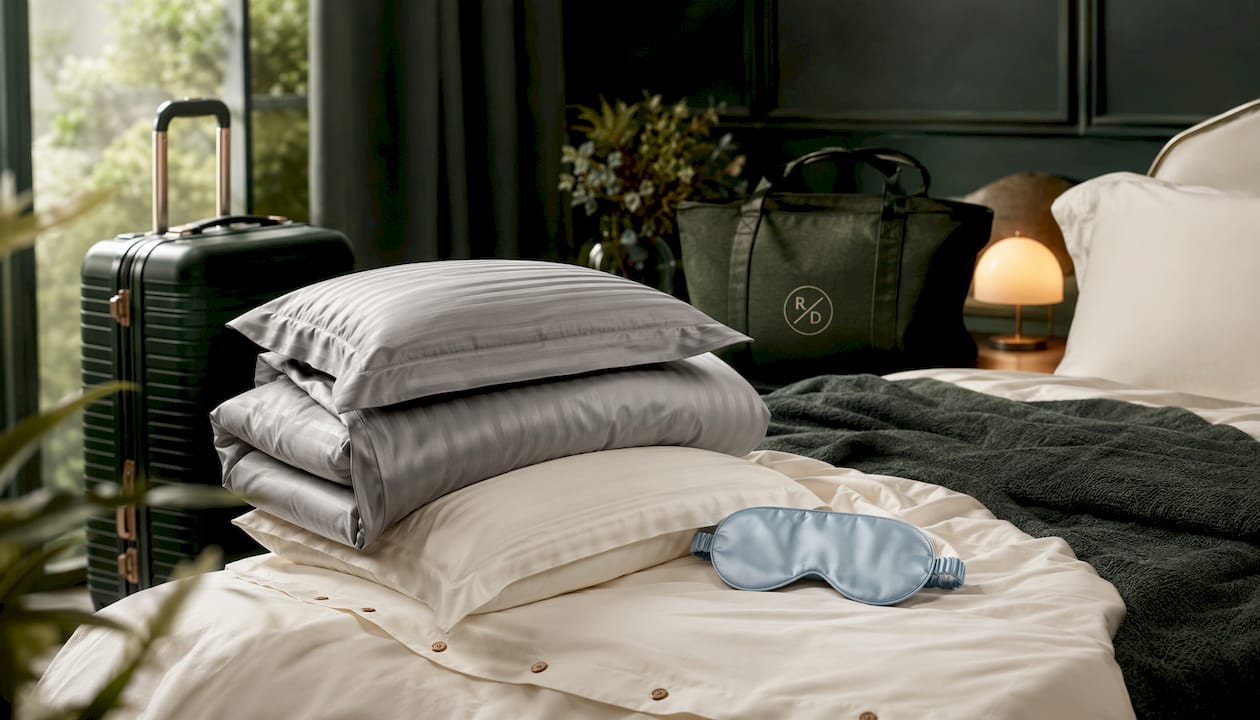
The Luxe Stripe 1200TC delivers exceptional softness and durability at a thread count that rewards every night’s sleep, whether you are at home or in a hotel suite. The PureComfort™ luxury set offers a high-thread-count finish designed for travellers who want the feel of premium bedding wherever they stay. Pair either set with Roomie Design’s sleeping mask for complete light control in any room. Every product is built around premium materials and refined construction, so the comfort you invest in at home follows you on the road.


