
Organic cotton vs regular cotton: a UK shopper's guide
Organic cotton generally causes less environmental harm than conventional cotton, but it costs more and is less widely available. For UK bedding buyers: if environmental impact is your priority, organic is the stronger choice; if budget or product range matters more, high-quality conventional cotton remains a sound option.
- Environmental wins for organic: no synthetic pesticides or fertilisers, lower greenhouse-gas emissions in many assessments, and measurable soil health benefits.
- Cost and availability trade-offs: organic cotton carries a price premium and a narrower product range in the UK market.
- Quality caveat: organic farming does not automatically produce softer or more durable fabric. Fibre length, thread count, and construction determine feel.
- Practical takeaway: for bedding, prioritise fibre quality and construction first, then weigh the environmental credentials of the source.
Table of Contents
- What does “organic cotton” actually mean compared with conventional cotton?
- How does each option affect the environment?
- Does organic cotton feel or wear better?
- Practical buying advice for UK shoppers
- How to spot vague or misleading “organic” claims
- What the research actually shows
- Roomie Design’s perspective on materials and environmental choices
- Roomie Design’s premium cotton sheets: quality construction, considered choices
- Sources
What does “organic cotton” actually mean compared with conventional cotton?
Organic cotton is grown without synthetic pesticides, artificial fertilisers, or genetically modified seeds. Farmers rely instead on biological pest control, crop rotation, and cover crops to manage soil fertility and pests. Conventional cotton, by contrast, uses a broader toolkit: synthetic herbicides, insecticides, and chemical fertilisers are standard practice in most major producing countries.
The difference does not stop at the farm gate. Processing matters too. Conventional cotton is often treated with chlorine bleaches, formaldehyde-based finishes, and synthetic dyes during manufacturing. Organic systems typically use lower-impact alternatives, though processing standards vary considerably by country and mill. This is why provenance and supply-chain transparency matter when you are evaluating a product’s environmental credentials, not just the farming label on the packet.
Seed choice is a practical dividing line. Organic growers must use non-GM seed, and sourcing it can be difficult in regions where GM varieties dominate. That constraint, combined with more labour-intensive weed management, partly explains why organic cotton costs more to produce.
How does each option affect the environment?
The environmental differences between organic and conventional cotton are real, though not always as clear-cut as marketing language suggests.
Key differences at a glance:
- Pesticide and chemical pollution: conventional cotton is one of the most chemically intensive crops grown globally. US conventional cotton used over 68 million pounds of pesticides in 2019, illustrating the scale of chemical inputs organic systems avoid.
- Soil health: organic management practices, including cover crops and rotations, can sequester soil carbon and improve soil structure over time, according to research on organic cotton production.
- Water use: organic systems are often rain-fed or use water-saving practices, reducing irrigation demand in many regions. However, water use differences depend heavily on local climate and variety, not on the organic/conventional label alone.
- Biodiversity: surveyed organic growers report improved on-farm biodiversity, with benefits for pollinators and soil organisms documented in peer-reviewed agricultural research.
- Climate impact: one life-cycle analysis cited in the Organic Center review reported energy demand 62% lower and global warming potential 46% lower for organic cotton on a per-yield basis, though results vary by study and region.
Trade-offs to know:
Organic cotton yields can be lower than conventional in certain conditions. This is a genuine consideration when assessing overall land-use impact.
| Metric | Organic cotton | Conventional cotton |
|---|---|---|
| Synthetic pesticide use | None | High (standard practice) |
| Greenhouse-gas potential | Lower in most LCA studies | Higher in most LCA studies |
| Soil carbon sequestration | Improved under good management | Variable; often lower |
| Water use | Often lower; region-dependent | Often higher; region-dependent |
| Typical yield | Can be lower in some regions | Generally higher per hectare |
Does organic cotton feel or wear better?
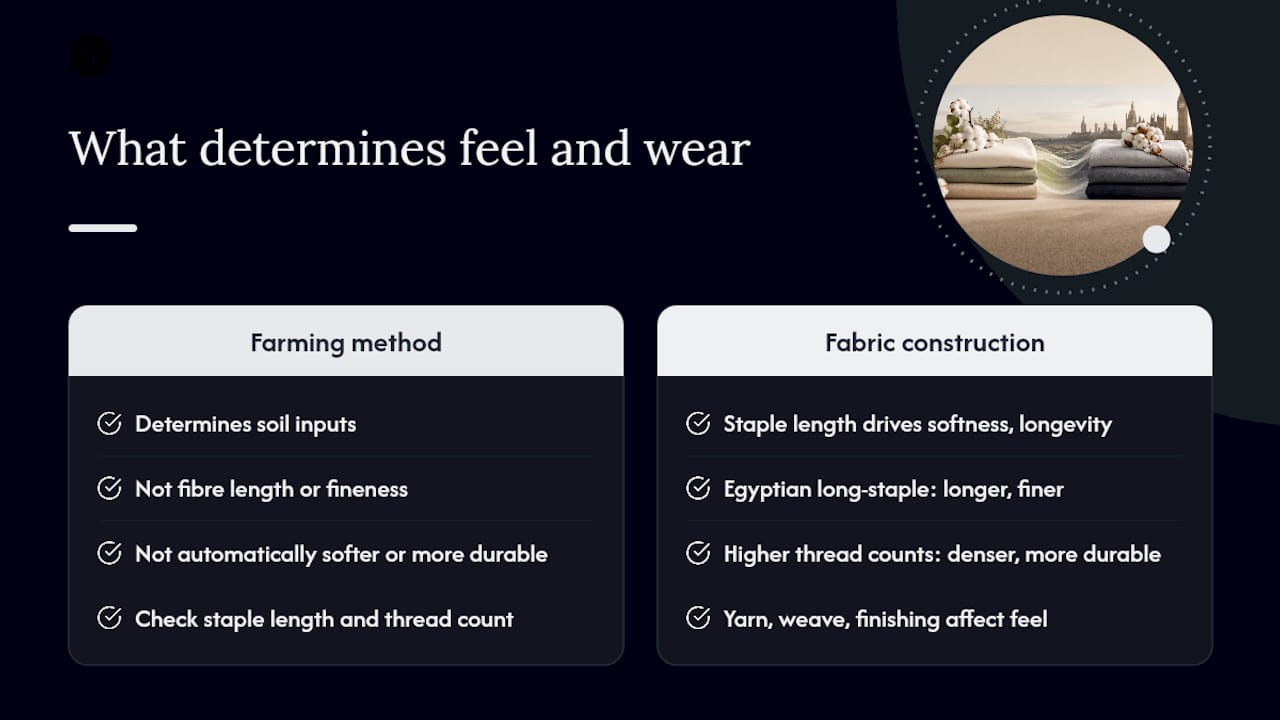
Organic cotton is not automatically softer or more durable than conventional cotton. The farming method determines what goes into the soil, not the length or fineness of the fibre that comes out. Softness and longevity are driven by staple length, yarn construction, weave, and finishing.
Extra-long staple varieties such as Egyptian cotton produce longer, finer fibres that create smoother, stronger yarns regardless of whether they were grown organically or conventionally. A 500 thread count sheet woven from long-staple Egyptian cotton will feel noticeably different from a 200 thread count sheet in any fibre type. Higher thread counts in quality constructions deliver a denser, more refined surface with excellent durability over repeated washing.
Pro Tip: When comparing sheets, check the staple length and thread count alongside the farming method. A well-constructed conventional Egyptian cotton sheet at 500 TC will often outperform a loosely woven organic sheet at 200 TC on both feel and longevity.
For care, cotton bedding at any thread count benefits from washing at 40°C or below to preserve fibre integrity, avoiding fabric softeners that coat fibres and reduce breathability over time. Practical tips for extending bedding lifespan apply equally to organic and conventional sheets.
Practical buying advice for UK shoppers
Organic cotton carries a price premium in the UK market, reflecting higher production costs and a more complex supply chain. The premium varies by product type, but organic cotton bedding typically costs noticeably more than comparable conventional options at the same thread count and construction quality.
Availability is improving. Textile Exchange market data documents rapid growth in organic cotton production and processing capacity, indicating rising supply-side investment. UK shoppers have more options than five years ago, though the range remains narrower than conventional.
Shopping checklist for UK bedding buyers:
- Fibre origin: where was the cotton grown? India, Turkey, and the US are major organic producers with different environmental profiles.
- Fibre composition: is it 100% cotton, or blended? Check the label.
- Staple length: long-staple or extra-long staple varieties offer superior feel and durability.
- Thread count: higher thread counts in quality constructions signal a denser, more refined weave.
- Processing: ask whether the fabric has been treated with chemical finishes after weaving.
- Provenance: overseas production adds a transport footprint; weigh farming practice against supply-chain distance.
For readers thinking beyond bedding, organic cotton curtains follow similar sourcing principles and are worth considering when refreshing a room’s soft furnishings.
A structured bedding selection process can help you weigh these factors systematically before purchasing.
How to spot vague or misleading “organic” claims
Some product pages use “organic” loosely, applying it to the raw fibre while the rest of the supply chain remains unverified. Supply-chain opacity is common: a product may use organic-grown cotton but be processed with conventional chemicals at the mill stage.
Red flags to watch for:
- “Made with organic cotton” with no percentage stated (could be a small fraction of the blend).
- No country of origin listed for the fibre or the fabric.
- Vague phrases like “natural”, “eco-friendly”, or “sustainably sourced” with no specifics.
- Claims about environmental benefits with no supporting detail on farming or processing methods.
- No information about dyeing or finishing processes.
Questions to ask retailers:
- What percentage of the product is organic cotton?
- Where was the cotton grown, and where was it processed?
- What dyeing and finishing treatments were used?
- Can you provide documentation for the organic status of the fibre?
Retailers with genuine traceability will answer these directly. Evasive or vague responses are a reliable signal that the claim is thin.
What the research actually shows
The academic and market evidence broadly supports organic cotton’s environmental advantages, with important caveats. A Cambridge-published survey found organic management improves soil health and biodiversity on many farms, but also identified practical challenges including weed control and organic-seed availability, with yield outcomes varying by region and season.
Life-cycle assessments cited by the Organic Center report substantial reductions in chemical inputs and, in some analyses, large advantages for energy demand and greenhouse-gas potential. These figures are compelling but not universal: results depend on the specific farm, region, and methodology used.
Textile Exchange’s market report documents rapid growth in organic cotton production and certified processing facilities, reflecting rising consumer demand and improving supply-side capacity.
The main evidence gaps are long-term comparative studies across diverse geographies and standardised LCA methodologies. Readers wanting the primary papers can access the Cambridge journal article and the Organic Center review directly via the sources listed below.
Roomie Design’s perspective on materials and environmental choices
At Roomie Design, material selection is guided by quality, construction, and the practical needs of shoppers who want bedding that performs night after night. Environmental considerations shape sourcing conversations, and the growing body of evidence on organic cotton’s benefits informs how the range is developed over time.
For shoppers ready to explore premium cotton options, the Botanical Sheet in Egyptian Cotton at 500 TC, the Botanical Sky Blue Sheet, and the Meadowsweet Sheet demonstrate what long-staple Egyptian cotton construction delivers at a high thread count. Questions about materials, sizing, or sourcing can be directed to Roomie Design’s customer support team via the website.
Roomie Design’s premium cotton sheets: quality construction, considered choices
Roomie Design’s Egyptian cotton sheets at 500 TC offer the combination most bedding shoppers are looking for: a dense, refined weave from long-staple fibre that softens with each wash and holds its shape over years of use.
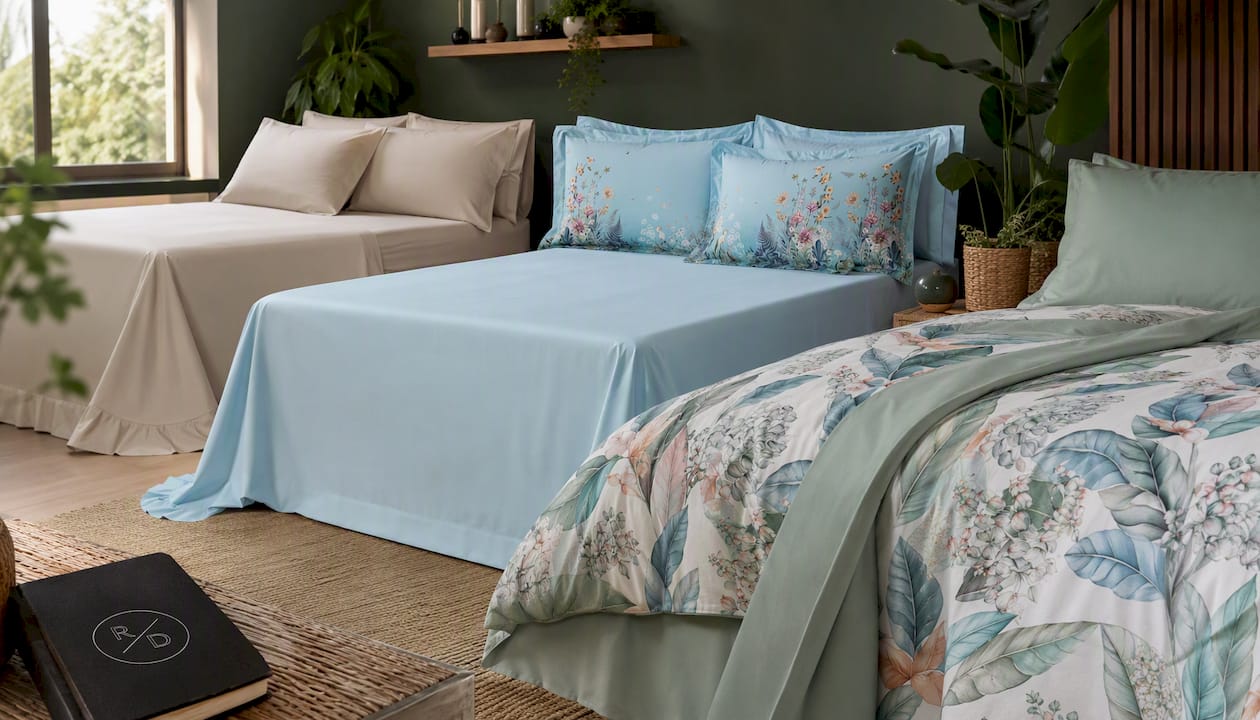
Three options suit different bedroom palettes. The Botanical Sheet (Egyptian Cotton, 500 TC) brings a classic, versatile finish. The Botanical Sky Blue Sheet adds a fresh, calm tone to any bedroom. The Meadowsweet Sheet suits a softer, nature-inspired palette. All three are available with full size guidance, customer reviews, and straightforward returns. View the full cotton bedding range at Roomie Design and contact the team with any sourcing or care questions.
Sources
These sources underpin the claims in this guide. Findings vary by region, cultivar, and study methodology, so reading the original papers alongside this summary is worthwhile.
- Organic cotton production may alleviate the environmental impacts of intensive conventional cotton production
- Organic Cotton: One of the most important choices you can make for the environment
- Textile Exchange: Organic Cotton Market Report 2021
- Conventional and Organic Cotton Production: Understanding Key Differences


