

How to organise bedding sets for a tidy bedroom
TL;DR:
- Organizing bedding sets effectively saves time, space, and reduces daily frustration by maintaining neat, accessible linen closets.
- Using proper folding techniques, vertical storage, and clear categorization helps keep sets together and prolongs their freshness.
- Consistent habits like rotating, airing, and limiting mismatched patterns ensure long-term system durability and a calm, organized bedroom environment.
Knowing how to organise bedding sets properly can save you a surprising amount of time, space, and daily frustration. Most linen closets reach a tipping point where fitted sheets are stuffed in randomly, pillowcases go missing, and pulling out one set means the whole stack collapses. It does not have to be that way. With the right folding methods, storage systems, and a few simple habits, your bedding can stay neat, accessible, and easy to maintain. This guide covers everything from decluttering your inventory to keeping your system working long term.
Table of Contents
- How to organise bedding sets: start with your inventory
- Folding methods that actually keep sets together
- Bedding storage solutions that maximise space
- Keeping your system working long term
- My take: why bedding organisation matters more than you think
- Premium bedding sets worth organising well
- FAQ
How to organise bedding sets: start with your inventory
Before you buy a single storage bin or basket, take everything out of your linen closet and lay it flat. You cannot organise what you have not audited.
Most bedding guides recommend keeping 2 to 3 sets per bed. That gives you one on the bed, one in the wash, and one spare. Beyond that, you are just storing clutter. If you have multiple beds in your home, keep a separate guest set on standby, labelled clearly and stored away from your everyday rotation.
Sort everything you pull out into three categories:
- Keep. Sets that are complete, in good condition, and the right size for your beds.
- Donate. Sets that are clean and usable but surplus to your actual needs.
- Discard. Anything pilled, stained, torn, or missing key pieces.
Pro Tip: Group each set by bed size before sorting further. Double and king sets mixed together create confusion during folding and retrieval, which is often what causes closets to fall apart in the first place.
Once you have a clear inventory, you can accurately plan how much shelf or drawer space you actually need. Smart organisation starts with knowing exactly what you are working with, not guessing.
Folding methods that actually keep sets together
This is where most people lose the battle. Poorly folded bedding wastes space and unravels the moment you try to retrieve a single set.
Fitted sheets
The fitted sheet folding method that works best involves a flat surface. Lay the sheet face down, tuck one corner into the other to create a smooth arc, then fold inward repeatedly until you have a neat rectangle. Trying to fold a fitted sheet while holding it up mid-air rarely ends well. Use your bed or a clean table instead.
Full sets, step by step
- Fold the flat sheet in thirds lengthways, then fold down to a compact rectangle.
- Fold the fitted sheet as described above, matching the same width as the flat sheet.
- Stack the flat sheet, fitted sheet, and one pillowcase neatly together.
- Slide the bundle inside the remaining pillowcase to create a self-contained parcel.
This is the sheet-in-pillowcase method, and it is genuinely useful. Each set stays together as one unit, stored vertically in a bin or shelf like files in a drawer. No more digging through a pile to find a matching set.
Duvet covers
For duvet covers, the burrito roll technique removes the usual struggle of getting a duvet into its cover. Turn the cover inside out, lay your duvet on top, roll both together from the top edge down, then invert the casing over the roll as you go. The duvet ends up perfectly centred and seated inside the cover. When storing the cover flat, fold it to match the size of your pillowcase parcels so your stacks stay consistent.
Pro Tip: Standardise your fold size across all sets. When every bundle is the same width and height, stacking becomes tidy and vertical storage works properly.
Bedding storage solutions that maximise space
Good bedding storage solutions are not about buying more. They are about using what you already have more intelligently.
Comparing common storage options
| Storage method | Best for | Ventilation | Accessibility |
|---|---|---|---|
| Labelled fabric bins | Everyday sets | Good | High |
| Magazine file holders | Vertical shelf storage | Good | High |
| Breathable cotton bags | Seasonal or guest sets | Good | Medium |
| Lidded bins with vents | Bulky duvets | Moderate | Medium |
| Under-bed flat storage | Seasonal bedding | Variable | Low to medium |
| Airtight plastic bags | Not recommended for everyday use | Poor | Low |
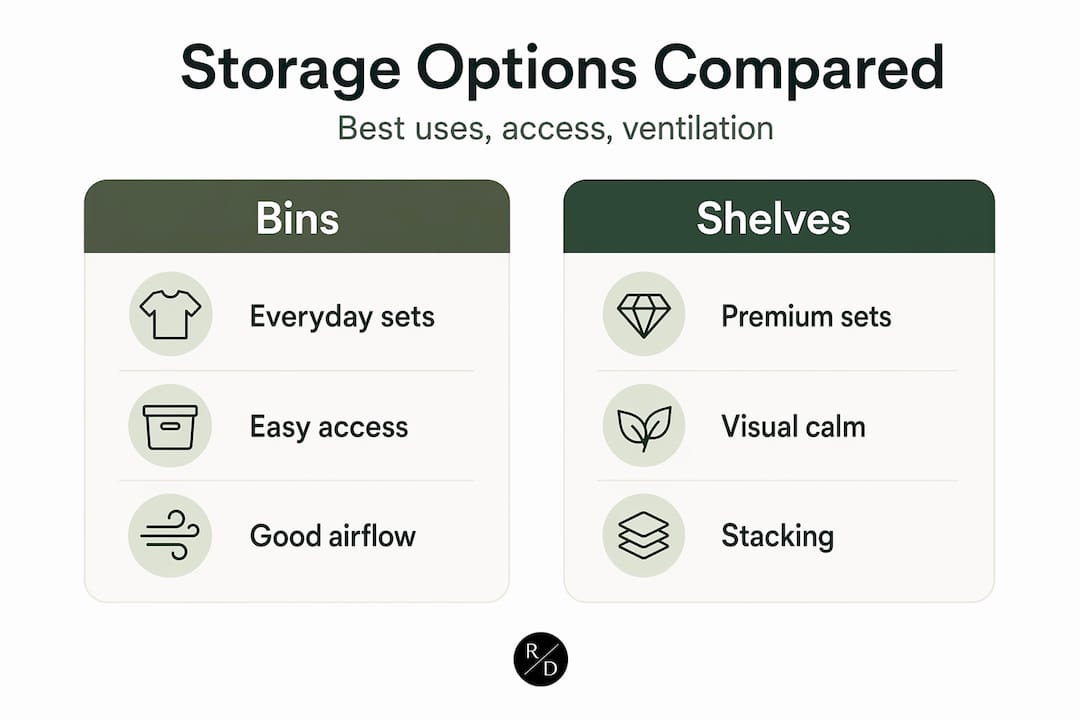
Airtight plastic bags trap moisture and can cause mildew or fibre degradation in quality bedding over time. For everyday sets, breathable fabric bins or open shelf storage works far better.
Here is how to put a practical system together:
- Sort and label shelves by bed size and season. King sets on one shelf, doubles on another, guest sets clearly marked.
- Store bundles vertically rather than stacking them horizontally. Vertical storage prevents the pile-tumble effect and lets you retrieve one set without disturbing the rest.
- Use shelf dividers if your closet shelves are wide. Without them, bundles slide and lean into each other over time.
- For compact bedrooms, under-bed storage in flat zip bags or shallow drawers works well for bulky seasonal duvets you only use a few months a year.
- Door-mounted fabric organisers are underused. They work well for spare pillowcases and thin throws.
Pro Tip: Limit yourself to two or three colours or tones across your stored bedding. A closet that looks visually calm is easier to maintain than one that looks chaotic, and you will be more motivated to keep it tidy.
Maintaining visual calmness through limited patterns and unified colour palettes is not just an aesthetic choice. It genuinely reduces the mental load of managing your linen supply. If you are choosing new sets to add to your collection, a guide on how to choose bedding for comfort and style can help you build a cohesive, manageable wardrobe of bedding from the start.
Keeping your system working long term
Organising your bedding once is straightforward. Keeping it that way takes a few consistent habits.
- Rotate sets regularly. Even wear across sets extends the life of your bedding significantly. Bring the freshly washed set to the back of the shelf and use from the front.
- Air bedding every three to six months. Hanging sets in indirect sunlight refreshes fibres and reduces dust without requiring a full wash. This is particularly useful for duvets and thick pillow inserts.
- Track your inventory. Each time you add a new set, remove an old one. Keeping a simple note on your closet door works well. Over-accumulation is the number one reason organised linen closets fall apart.
- Deal with wrinkles at source. Fold sets immediately after tumble drying while still slightly warm. This reduces creasing without ironing and keeps bundles flat.
- Avoid pattern overload. Storing too many mismatched prints makes retrieval confusing and makes the closet feel disorganised even when it technically is not. Stick to coordinating colours and limit bold patterns to one or two sets per bedroom.
My take: why bedding organisation matters more than you think
I have seen dozens of well-designed bedrooms where the hidden chaos of the linen closet quietly undermined the whole experience. A beautiful bedroom with an unmanageable pile of mismatched bedding somewhere nearby creates a low-level sense of disorder you cannot always place.
What I have found, time and time again, is that people underestimate how much the retrieval experience affects the rest of their routine. When you can pull out a clean, matched set in under ten seconds, without rummaging, it just sets the tone differently. Bed changes stop feeling like a chore.
The folding matters more than the storage product. You can spend money on beautiful wicker baskets, but if the sheets are stuffed in them in random shapes, the system will not hold. Consistent folding creates the foundation everything else rests on.
My honest recommendation: spend thirty minutes on one proper declutter and fold session, get everything into uniform bundles, and store them vertically. That single session tends to hold for months with very little maintenance. It is worth doing properly once rather than patching a disorganised system repeatedly.
— Roomie
Premium bedding sets worth organising well

If you are refreshing your bedding inventory as part of this process, it is worth replacing worn sets with options that store neatly and feel genuinely luxurious. Roomie-design carries a curated range of luxury duvet cover sets crafted from premium materials including 1000 TC Egyptian cotton, mulberry silk, and lyocell. Sets like the Dusty Rose Mulberry Silk Duvet Cover and the Prestige Beige 1000 TC collection pair elegance with practical sizing for clean, consistent storage. Explore the full Roomie-design range to find sets that complement both your sleep comfort and your newly organised linen closet.
FAQ
How many bedding sets should I keep per bed?
Most storage experts recommend 2 to 3 sets per bed: one in use, one freshly washed, and one spare. A separate guest set can be stored in a labelled bag.
What is the best way to store bedding sets?
Fold each set into a bundle using the sheet-in-pillowcase method, then store vertically in a labelled fabric bin or on a shelf. Vertical filing prevents pile collapse and makes retrieval quick.
Can I store bedding in plastic bags?
Avoid airtight plastic bags for everyday bedding. Trapped moisture can cause mildew and degrade fibres over time. Use breathable cotton bags or ventilated bins instead.
How do I fold a fitted sheet neatly?
Lay the fitted sheet flat on a surface, tuck one elasticated corner into the other to form a smooth edge, then fold inward into a neat rectangle. Using a flat surface rather than holding the sheet in the air makes the process far easier.
How often should I air out my stored bedding?
Air bedding every 3 to 6 months by hanging sets in indirect sunlight. This refreshes the fibres, reduces dust accumulation, and keeps stored sets smelling clean without a full wash cycle.


