

Why colour blocking in bedding transforms your bedroom
TL;DR:
- Colour blocking in bedding influences mood and space definition through deliberate use of contrasting colors. It offers a low-cost, impactful way to refresh a bedroom, emphasizing personalization and cohesive design. Following the 60-30-10 rule and testing colors in different lights ensures balanced, visually appealing results that enhance any bedroom style.
Bedding is the most visible design element in any bedroom, yet most people treat it as purely functional. That overlooks a significant opportunity. Understanding why colour blocking in bedding matters goes well beyond aesthetics. It is a deliberate technique for shaping mood, defining space, and expressing personal style without touching a single wall. As interest in bedroom design continues to grow in 2026, colour blocking has moved from fashion runways into living spaces, offering a low-cost, high-impact way to completely rethink how your bedroom feels and functions.
Table of Contents
- Key takeaways
- Why colour blocking in bedding works by design
- Benefits of colour blocking bedding
- Colour blocking design tips and common pitfalls
- Colour blocking bedding ideas for every style
- My take on colour blocking as a lasting bedroom trend
- Achieve the look with Roomie-design’s collections
- FAQ
Key takeaways
| Point | Details |
|---|---|
| Mood follows colour | Deliberate colour block combinations influence energy and relaxation within your bedroom. |
| Cost-effective refresh | Colour blocking via bedding updates a room’s entire feel without renovation or repainting. |
| The 60-30-10 rule applies | Use 60% dominant, 30% supporting, and 10% accent colour to keep blocks balanced and polished. |
| Saturation consistency matters | Stick to one intensity band across all bedding pieces to avoid a disjointed look. |
| Trends support bold choices | 2026 colour themes like earthy tones and rich saturated hues make now an ideal time to experiment. |
Why colour blocking in bedding works by design
Colour blocking in textiles means placing two or more distinct, clearly defined colour areas together without gradients or patterns softening the boundary. In bedding, this translates to a duvet in one colour, pillowcases in another, and a throw or cushions in a third. The effect is structured and intentional.
Colour theory underpins why this works so well. Hue, tone, and saturation all interact when colours sit side by side on a bed. High-contrast pairings like deep navy against warm terracotta read as energising and bold. Lower-contrast combinations like dusty sage with warm cream feel calm and restful. Colour blocking creates mood zones in modern bedrooms through these deliberate choices, with designers recommending deep blue and warm gold for vitality or soft pink and cream for serenity.
Beyond mood, colour blocks have a direct spatial effect. Horizontal blocks across a bed visually widen a narrow room. Vertical arrangements on cushion stacks draw the eye upward, making ceilings feel higher. Bold blocks on a bed anchor the room and give the space a focal point without the need for furniture changes.
Key spatial effects colour blocking delivers:
- Grounding: A deep, saturated duvet grounds the bed as the room’s centrepiece
- Elongation: Vertical pillow arrangements in two contrasting tones add visual height
- Visual rhythm: Repeating blocks across duvet, throws, and cushions creates cohesion
- Zone definition: Distinct colour areas signal rest versus reading areas within a larger bedroom
Dopamine décor uses bold hues and colour blocks to stimulate joy, creativity, and vitality. This is not accidental styling. It is applied colour psychology with your bedding as the canvas.
Benefits of colour blocking bedding
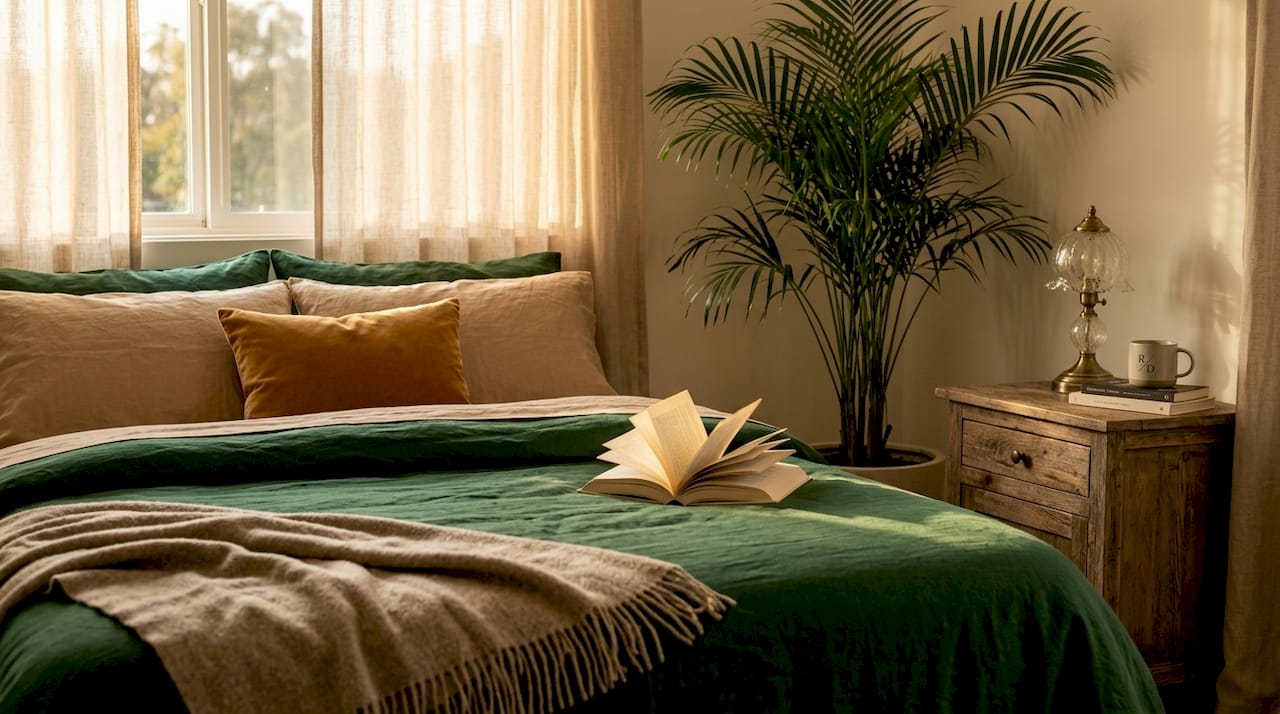
Colour blocking via bedding is one of the most practical ways to refresh a room. No paint, no new furniture, no contractor required. Repeating two to three anchor colours used throughout a home creates cohesion without renovation, making bedding an accessible starting point for anyone wanting a design update.
Here are the core benefits:
- Refreshes the room at low cost. Swapping a duvet cover set and two pillowcases in a considered colour block palette delivers a completely different bedroom mood for a fraction of what paint or soft furnishings would cost.
- Creates visual depth and dimension. Layered bedding in distinct colour blocks adds a three-dimensional quality to the bed. The result looks styled rather than assembled.
- Customises mood on demand. Choosing calming tones for rest or brighter blocks for an energised start to the day means your bedroom adapts to how you want to feel.
- Achieves professional cohesion. Limiting a home’s palette to three to five hues used across rooms with variation produces a polished, designer result.
- Supports personal expression. Colour blocking is trend-forward styling that still allows individual choices. You choose the palette, the contrast level, and the arrangement.
Pro Tip: When selecting your colour block palette, pull one colour directly from an existing element in the room, such as a rug or artwork. This grounds the new bedding within the space immediately and prevents the bed from feeling disconnected from the rest of the room.
Colour blocking adds visual rhythm and defines architectural features cost-effectively, making it as suitable for a budget refresh as it is for a considered luxury upgrade. For more on how to style bedding for maximum visual impact, Roomie-design’s guides offer practical, room-specific direction.
Colour blocking design tips and common pitfalls
Getting colour blocking right in bedding comes down to a small number of consistent decisions. Making the wrong ones is equally quick, but easy to avoid once you know what to look for.
| Design decision | Right approach | Common mistake |
|---|---|---|
| Palette selection | Choose an anchor colour and build around it | Mixing unrelated colours with no common thread |
| Saturation levels | Keep all pieces within one intensity band | Mixing neon and pastel creates a disorganised look |
| Undertone compatibility | Match warm to warm, cool to cool | Clashing undertones cause disharmony in side-by-side colours |
| Balance | Apply the 60-30-10 rule across bedding layers | Filling all layers with equally loud blocks |
| Light testing | Check colours in both natural and lamp light | Choosing colours in artificial light only |
The 60-30-10 rule is particularly useful in bedding colour blocking. Sixty per cent of the bed should carry the dominant colour, typically the duvet or fitted sheet. Thirty per cent belongs to the supporting colour, usually the pillowcases or a throw. The remaining ten per cent is the accent, seen in scatter cushions or a bedside accessory. This distribution keeps bold blocks from overwhelming the eye.
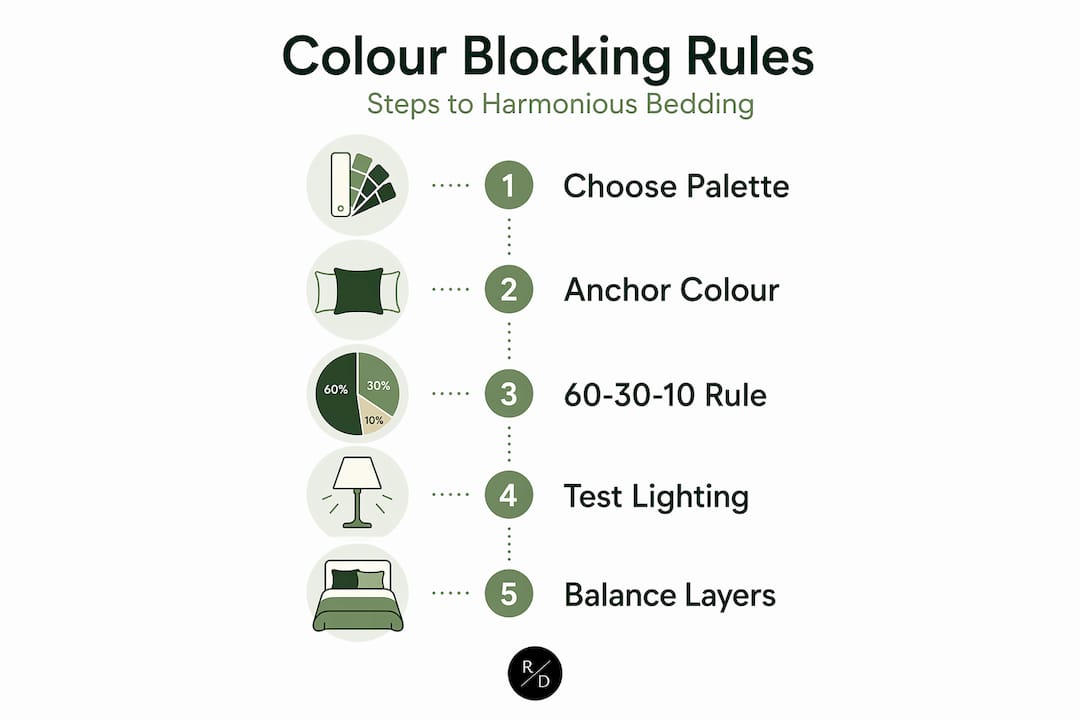
Testing colours under different light conditions is a step many people skip. A pairing that looks harmonious in the shop or on a screen can shift dramatically under warm evening lamplight. Natural daylight reveals true undertones, while lamplight shows how the combination settles at the end of the day.
Pro Tip: If you are new to colour blocking, start with a neutral base. A bedding guide for stylish comfort can help you identify which neutral foundations support the boldest accent blocks without the room feeling chaotic.
Colour blocking bedding ideas for every style
The range of colour blocking bedding ideas spans from barely-there tonal shifts to full-contrast statement beds. Both approaches work. The key is matching the intensity of the colour block to the energy you want in the room.
- Subtle tonal blocking: Two shades of the same colour family, such as blush and deep rose, or warm grey and charcoal, create a restful, sophisticated look. This approach suits those who want definition without bold contrast.
- Bold contrasting blocks: Pairing deep jewel tones like forest green against warm cream or dusty rose against slate reads as confident and directional. The rise of Pomegranate Pop shows how saturated bedding injects movement and visual tension into otherwise neutral rooms.
- Geometric block shapes: Rather than simply choosing different coloured pieces, consider bedding with block geometry built into the fabric itself. Horizontal panels create width; diagonal blocks introduce movement.
- Layered component blocking: Use the duvet, pillowcases, a folded throw across the foot of the bed, and scatter cushions as four distinct layers. Each can carry a colour within your palette.
- Earthy 2026 tones: Terracotta, warm taupe, dried clay, and deep ochre are prominent in 2026 colour trends. These tones block beautifully together and work in rooms ranging from minimal to maximalist. Renters particularly benefit here, as these palettes suit a wide range of fixed wall colours.
For a broader look at bedroom design ideas, Roomie-design’s style guides cover current trends with product-specific direction.
My take on colour blocking as a lasting bedroom trend
I’ve worked with enough bedrooms to know that trends cycle quickly. Colour blocking is different. What I’ve observed is that it persists not because it is fashionable but because it genuinely works at a functional level. Rooms styled with considered colour blocks feel calmer or more energised depending on the palette. That is a practical benefit, not just a visual one.
What I’ve learned through experience is that most people underestimate how much their bedding affects how they feel when they wake up. A bed dressed in a flat, single-colour scheme does nothing to signal a mood. A bed with a deliberate, three-colour block tells the room what it is for.
My consistent observation is this: the people who are happiest with their bedrooms are those who treat the bed as the design centrepiece rather than an afterthought. Colour blocking makes that achievable at any budget. It also ages better than pattern-heavy choices, because the simplicity of a well-chosen block palette stays clean over time. Premium textures in those colours, such as silk or high-thread-count cotton, only make that effect stronger.
— Roomie
Achieve the look with Roomie-design’s collections
Colour blocking works best when the bedding quality matches the design ambition. Roomie-design’s collections are built for exactly this kind of layered, palette-led styling.
The Dusty Rose Mulberry Silk Duvet Cover Set is a standout choice for soft, elegant colour blocks. Its 22mm mulberry silk brings a texture and sheen that makes even a two-tone arrangement feel considered. For a grounding anchor colour in a richer palette, the Espresso 1000 TC Duvet Cover Set delivers depth and warmth in a luxurious, high-thread-count fabric. Those building around a neutral base will find the Prestige Beige 1000 TC Egyptian Cotton Set an ideal foundation that lets accent blocks take centre stage. Every piece is designed with quality and layering in mind.
FAQ
What is colour blocking in bedding?
Colour blocking in bedding means placing two or more clearly defined, contrasting or complementary colours across bedding components such as duvets, pillowcases, and throws without blending or gradients between them.
Why choose colour blocking for bedding rather than patterned sets?
Colour blocking offers cleaner visual impact and ages better than busy patterns. It also allows more control over mood and palette coordination within an existing room scheme.
How do I colour block bedding without it looking mismatched?
Apply the 60-30-10 rule across your bedding layers, keep saturation levels consistent across all pieces, and test colours under both natural and artificial light before committing.
What are the best colour combinations for colour blocking bedding in 2026?
Earthy tones such as terracotta, warm taupe, and ochre are strong choices for 2026, alongside bold pairings like dusty rose with slate or deep blue with warm gold for higher-contrast schemes.
Does colour blocking work in small bedrooms?
Yes. Horizontal colour blocks across the bed visually widen a narrow room, while keeping the dominant block in a lighter tone prevents the space from feeling enclosed.


