Egyptian cotton: comfort, quality, and fibre secrets
TL;DR:
- Egyptian cotton refers to specific long-staple cotton varieties grown in Egypt’s Nile Delta, characterized by measurable fibre properties like length and strength. The final bedding quality depends on manufacturing factors such as spinning, weaving, and finishing, which influence texture and durability beyond mere fibre origin. To choose genuine Egyptian cotton bedding, prioritize certified origin, appropriate yarn and weave types, and transparent product specifications over simple thread count labels.
Egyptian cotton carries one of the most recognised names in bedding, yet the label alone tells you surprisingly little about what you will actually feel when you climb into bed. The fibre’s origin is only the starting point. Its measurable physical properties, the way it is spun, woven, and finished all determine whether a sheet feels genuinely luxurious or simply ordinary. This guide breaks down what Egyptian cotton really means, what the science says about its fibre characteristics, and how you can use that knowledge to make a confident, well-informed bedding choice.
Key Takeaways
| Point | Details |
|---|---|
| Fibre quality matters | Egyptian cotton fibres are generally longer, stronger, and softer compared to regular cotton, leading to enhanced comfort. |
| Manufacturing impacts feel | The spinning, weave, and finishing methods play a crucial role in the comfort and durability of Egyptian cotton bedding. |
| Thread count isn’t everything | High thread counts only deliver quality if backed by premium fibres and proper weaving techniques. |
| Check for authenticity | Choose Egyptian cotton bedding with fibre origin certification and reputable manufacturers for genuine quality. |
Egyptian cotton: what it really means
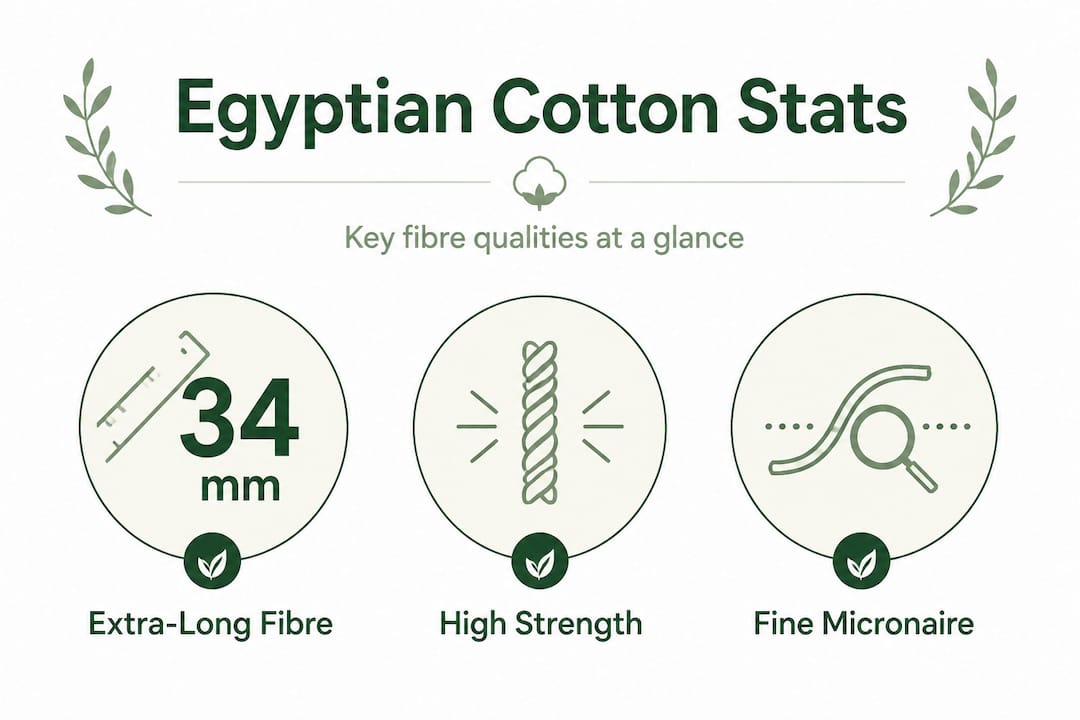
Egyptian cotton is not simply cotton that happens to be grown in Egypt. It refers to specific long-staple and extra-long-staple cotton varieties cultivated in the Nile Delta region, where the climate and soil conditions have historically produced fibres with distinct measurable qualities. Those qualities include fibre length, tensile strength, and micronaire, a measurement of fibre fineness and maturity.
Egyptian cotton fibre properties such as length, strength, and micronaire are measurable and well-documented in technical literature, confirming that origin is only one part of the quality picture. Fibre metrics studied across Egyptian cotton varieties show clear, quantifiable differences between types.
Many consumers assume that any bedding labelled “Egyptian cotton” will automatically feel softer or last longer. That assumption misses several important steps between raw fibre and finished sheet. Consider the key properties that set genuine Egyptian cotton apart:
- Fibre length: Longer fibres allow for finer, stronger yarns with fewer surface ends, which reduces pilling.
- Tensile strength: Higher-strength fibres withstand repeated washing without breaking down quickly.
- Micronaire: A lower micronaire value indicates a finer, more mature fibre that feels smoother against skin.
- Uniformity: Consistent fibre length across a batch produces more even, predictable yarn.
You can explore how these properties translate into finished products by looking at Egyptian cotton luxury sheets as a practical reference point. With misperceptions clarified, let’s explore the science behind Egyptian cotton’s celebrated fibre characteristics.
The science behind Egyptian cotton fibres
Egyptian cotton is not a single uniform product. It encompasses several named varieties, each with its own fibre profile. Giza 86, one of the most cited premium varieties, produces fibres averaging around 34 mm in upper half mean length (UHML), a standard industry measurement, combined with high strength ratings. That combination allows spinners to produce very fine, high-quality yarn.

Technical studies confirm that Egyptian varieties differ measurably in fibre length, strength, and brightness across types, meaning the variety matters as much as the country of origin.
| Variety | UHML (mm) | Strength (g/tex) | Micronaire |
|---|---|---|---|
| Giza 86 | ~34 | High | Fine |
| Giza 94 | ~33 | Medium-high | Medium-fine |
| Giza 90 | ~31 | Medium | Medium |
| Short-staple Egyptian | ~27 | Lower | Coarser |
Key insight: A sheet labelled “Egyptian cotton” could be made from Giza 86 long-staple fibre or from a shorter-staple variety. These are not the same product from a comfort or durability standpoint.
Here is how fibre metrics matter in practice:
- Upper half mean length (UHML): Fibres above 28 mm are considered long-staple. Above 34 mm is extra-long-staple. The longer the fibre, the finer the potential yarn.
- Strength: Measured in grams per tex. Higher values mean the yarn resists breakage during weaving and washing.
- Micronaire: Values between 3.5 and 4.2 are generally considered ideal for premium bedding applications.
- Brightness: Whiter, brighter fibres require less chemical bleaching to reach the finished colour, which can preserve fibre integrity.
Products such as the concentric Egyptian cotton bedding and Egyptian cotton sheet sets are built around these higher-grade fibre specifications. Having examined the fibre properties, we now look at how these translate into real-world bedding comfort and performance.
From fibre to fabric: what shapes your bedding experience
Even the finest Egyptian cotton fibre can produce an underwhelming sheet if the manufacturing steps are poorly executed. Spinning, weaving, and finishing each introduce variables that shape what you ultimately feel.
Spinning converts raw fibre into yarn. Ring-spinning is the traditional method and produces a denser, smoother yarn than open-end spinning. For premium Egyptian cotton bedding, ring-spun or combed ring-spun yarns are the standard to look for.
Weave structure creates two dominant fabric types in the bedding market:
| Weave type | Feel | Breathability | Best suited for |
|---|---|---|---|
| Percale | Crisp, cool, matte | High | Warm sleepers, summer |
| Sateen | Smooth, silky, lustrous | Moderate | Year-round, cooler climates |
Technical variability in fibre and yarn traits across varieties and yarn-count settings means that identical thread counts can produce noticeably different fabrics depending on these downstream choices.
Finishing includes processes such as mercerisation (treating cotton with alkali to increase lustre and dye uptake), singeing (burning off surface fibres to reduce pilling), and calendering (pressing fabric to improve smoothness). Each step adds cost, but also adds measurably to the final product’s quality.
Pro Tip: When comparing Egyptian cotton bedding, look beyond thread count. Check whether the product specifies ring-spun yarn, combed cotton, and the weave type. These details tell you far more about how the fabric will feel.
Options such as beige Egyptian cotton bedding and botanical Egyptian cotton sheets are useful examples of how weave choice and finishing decisions result in clearly different aesthetics and feels within the same fibre category. Understanding how fibre turns into fabric helps you make informed choices when shopping for bedding.
Choosing Egyptian cotton bedding: what to look for
Not all Egyptian cotton bedding delivers the same comfort, because measurable variability in fibre and yarn traits means that manufacturing choices determine a large part of the end result. Here is a practical framework for evaluating your options.
- Check for fibre origin certification. Look for certifications such as the Cotton Egypt Association’s Supima or Egyptian Cotton marks. These provide verified assurance that the fibre genuinely originates from Egypt’s long-staple crops.
- Evaluate thread count in context. A 400 TC percale sheet made with single-ply, long-staple fibre can outperform a 1000 TC sheet made with multi-ply, short-staple yarn. Thread count is meaningful only when the fibre and construction quality are already high.
- Identify the weave type. Percale offers a cool, crisp feel ideal for warmer sleepers. Sateen has a smoother, slightly warmer drape that suits those who prefer a softer texture.
- Ask about yarn type. Ring-spun and combed yarns represent higher quality than open-end spun alternatives.
- Review brand transparency. Reputable makers publish fibre details, yarn specifications, and certifications. If a product listing offers only “Egyptian cotton” without further detail, treat that as a signal to look closer.
Key factors to prioritise at a glance:
- Fibre certification or named variety (e.g., Giza 86 or similar)
- Single-ply, ring-spun or combed yarn construction
- Specified weave type (percale or sateen)
- Thread count appropriate to the weave (200 to 400 TC for percale; 300 to 600 TC for sateen is typical for quality products)
- Laundering guidance that confirms the fabric has been pre-shrunk or pre-washed
A product such as the premium Egyptian cotton 1000 TC set illustrates how a verified high thread count, combined with known fibre quality and correct construction, produces a measurably different sleeping experience. Now that you know how to assess Egyptian cotton bedding, let’s consider the expert perspective on navigating these choices.
What most guides miss about Egyptian cotton
The standard advice you encounter online tends to reduce Egyptian cotton to a simple equation: longer fibre equals better bedding. That is a useful starting point, but it leaves out most of what actually matters.
We see this clearly when customers compare products side by side. Two sheets, both labelled “Egyptian cotton 1000 TC,” can feel entirely different because one uses single-ply combed yarn in a percale weave with mercerised finish, while the other uses two-ply twisted yarn in a sateen weave with a softer chemical finish. Same label, genuinely different product.
Thread count has also become a marketing tool more than a quality indicator. A high thread count achieved through multi-ply yarns does not add softness. It adds weight. Experienced buyers tend to prioritise weave type, yarn quality, and finishing over raw thread count numbers.
The expert approach is straightforward. Choose makers who are transparent about their fibre sourcing and construction. If possible, feel the fabric before buying, or rely on verified reviews from people who describe texture and durability over time. Look at options like the lounge Egyptian cotton bedding to see how specification transparency looks in practice.
Experience luxurious Egyptian cotton bedding
Putting this knowledge to work is straightforward with the right starting point.
Roomie Design’s Egyptian cotton range covers a variety of thread counts, weave types, and designs, from the structured elegance of the prestige beige duvet cover set to the refined simplicity of the botanical sheet Egyptian cotton. Each product is built around verified fibre quality and clearly stated construction details, so you can apply what you have learned here directly to your selection. Browse by thread count, weave, or design style to find the combination that suits your sleep preferences and bedroom aesthetic.
Frequently asked questions
How is Egyptian cotton different from regular cotton?
Egyptian cotton has longer, finer fibres that are measurably superior in length and strength, producing softer, more durable, and more absorbent fabric than standard short-staple cotton.
Does thread count matter in Egyptian cotton bedding?
Thread count is meaningful only when fibre and weave quality are already high. Variability in yarn traits across varieties means a lower thread count with premium construction can outperform a higher count with inferior materials.
Can Egyptian cotton bedding feel different depending on the manufacturer?
Yes. Downstream manufacturing factors such as spinning method, ply, weave structure, and finishing processes significantly affect the texture, durability, and overall comfort of the finished bedding.
What are the signs of genuine Egyptian cotton?
Look for fibre origin certification from a recognised body, clearly stated yarn type and weave, and a brand that publishes specific product details rather than relying on the label alone.
Recommended
- Egyptian Cotton 1000 TC Luxury Sheet Designer Bedding Set – Roomie Design
- Botanical Sheet (Egyptian Cotton, 1000 TC) Luxury Designer Bedding Set – Roomie Design
- Concentric Sheet (Egyptian Cotton, 600 TC) Luxury Designer Bedding Set – Roomie Design
- Essence Sheet 1000 TC Egyptian Cotton Luxury Designer Bedding Set – Roomie Design


