
Multi-Currency Checkout: How It Works and What to Check
Multi-currency checkout lets you see prices and pay in your own currency, such as pounds, euros or dollars, instead of the currency of the shop’s home country. It covers the price shown on the product page, the total at checkout, the exchange rate used, and the amount your card is charged. This guide explains each step. It also shows what to check before paying, which matters most when you buy bedding from an international shop like Roomie Design.
Key Takeaways
- Multi-currency checkout covers more than a price label. It includes the currency you pay in, the conversion, payment methods, taxes and refunds.
- Two setups exist: prices shown in your currency with the charge made in another, or a charge made in your own currency. Check which one applies at the payment step.
- Your bank may add its own international transaction fee even when the charge is in your local currency. Your card terms tell you.
- Refunds on foreign-currency orders can be converted at the rate on the refund date, so the refunded amount can differ slightly from the original conversion.
- For bedding, confirm size and fabric first, then currency and delivery, then pay. The size guide removes the most common return reason before checkout.
Table of Contents
- What multi-currency checkout means
- How prices are displayed and payment is taken
- Exchange rates and fees: what can apply
- Refunds and returns in another currency
- Payment methods and country rules
- A checklist before you pay
- For shops and retailers: setting up multi-currency checkout
- Our perspective on shopping bedding in your own currency
- Shop bedding at Roomie Design
- FAQ
- Sources
What multi-currency checkout means
A checkout is multi-currency when it can display or accept more than one transaction currency. In practice it usually covers currency selection, localised prices, conversion, payment-method eligibility, rounding, taxes and order currency capture. The term is wider than multi-currency pricing, which only concerns the price you see.
Visa describes multi-currency pricing as something e-commerce merchants typically offer by assessing the cardholder’s location and displaying prices in the domestic currency or in several selectable currencies. The merchant then receives settlement and reports in its own home currency or a currency of its choice.
For a shopper the benefit is simple. You compare a duvet cover set or a pair of sheets against what you normally spend, without working out exchange rates in your head. Stripe notes that showing the local currency avoids mental conversion and worries about hidden exchange fees or an uncertain final charge.
How it relates to multi-currency e-commerce
Multi-currency e-commerce is the whole business model: a shop selling to buyers in many countries, with prices, payment methods and delivery set up for each market. Multi-currency checkout is the part of that model you touch at the moment of payment. Localising usually also includes region-specific payment methods, translated interfaces and local regulatory compliance, which is why the checkout you see can differ from country to country.
How prices are displayed and payment is taken
The sequence is the same across most online shops:
- You choose a currency, or the shop suggests one based on your location.
- Product prices, shipping and the cart total show in that currency.
- At payment, the amount is converted at the current rate if the shop’s own currency differs. The rate may include a markup or fee.
- You authorise the payment, and the payment processor verifies it and settles the funds to the seller.
The important detail sits in step 3. Two different setups share the name “multi-currency checkout”.
Setup one: display conversion
The shop shows you converted prices, but the card is still charged in the shop’s base currency. Your card issuer then converts at its own rate. This is the display-conversion model. The price you saw is an estimate, and the final amount appears on your card statement.
Setup two: charging in your currency
The card is charged in your own currency, called the presentment currency, and the seller’s payment processor converts the funds on its side. The conversion cost and the refund exchange-rate effect then sit with the seller rather than with you. The price you see at checkout is the price charged, which is the clearest experience for the buyer. Stripe recommends charging in the same currency that is displayed wherever possible, to avoid foreign-transaction surprises.
Dynamic currency conversion at a payment terminal
You may also meet dynamic currency conversion, where the shopper sees both currencies and the exchange rate at the moment of payment. Global Payments separates this from multi-currency pricing, which displays local prices while settling in a base currency. It also notes that card-network rules require genuine cardholder choice and clear disclosure for this option. If a screen offers you a choice between currencies, read both totals and pick the one you prefer.
Exchange rates and fees: what can apply
Three layers can affect the final amount. Knowing them lets you read a checkout page quickly.
| Layer | What it is | Where to see it |
|---|---|---|
| Exchange rate | The rate used to turn one currency into another. Platforms commonly describe a mid-market rate based on third-party data, plus a conversion fee. | Checkout total, or a note near it |
| Platform conversion fee | Some storefront platforms include a conversion fee in the displayed price. Shopify, for example, states that with automatic rates a fee of 1.5% or 2%, depending on store location, is included in the displayed price. | Already inside the price shown |
| Card issuer fee | Some banks and card issuers charge international transaction fees even when the card is charged in the customer’s local currency. The bank sets and collects these. | Your card terms and statement |
BigCommerce’s help centre makes a related point: paying in your native currency may help you avoid bank or funding-institution conversion fees. It also notes that if your card-issuing bank is in a different country from the merchant’s bank account, additional cross-border fees may apply.
Card networks decide whether a transaction is cross-border by geography: the country where the card was issued compared with the country of the merchant and its acquirer. Currency does not change that. So even a checkout in pounds can still be treated as an international payment by your bank. If you shop abroad often, a card with no foreign-transaction fee is a practical way to keep totals predictable.
A quick way to compare totals
Before paying, take the total in your currency and compare it with the card statement after the order. If the two match, the charge was made in your currency. If they differ by a small amount, the issuer converted the payment itself. Keep the order confirmation, which records the order currency, for any later question.
Refunds and returns in another currency
Refunds are where currency choice shows up most clearly. Stripe’s documentation warns that a refund or dispute may be converted at the current exchange rate, so the amount the seller deducts can be higher or lower than the original payment. The customer, in turn, is refunded the exact amount paid in the payment currency.
Shopify’s help centre adds that for an order placed in a foreign currency, the refund amount in the payout currency depends on the exchange rate at the time of the refund, not at the time of the original order. For you as the buyer, the practical rule is this: when you pay in your own currency, the refund goes back in that same currency. When a display-conversion setup is used, your bank converts both legs, so a small difference between the original charge and the refund is possible.
Before ordering bedding, check the size first. Mattress dimensions differ between countries, and a wrong size is the most avoidable reason for a return. The Roomie Design size guide lists dimensions so you can match duvet covers, fitted sheets and pillowcases to your bed. Our duvet cover sets and sheets pages organise products by size, fabric and thread count.

Payment methods and country rules
The payment methods you see depend on where you are. Local methods can depend on customer geography, checkout currency, price limits, payment type and merchant settings. iDEAL in euros and Swish in Swedish krona are typical examples. A shopper in the Netherlands and a shopper in Sweden can therefore see different options on the same shop.
Some storefront platforms also support selling in local currencies only through particular payment providers. Orders placed with other third-party providers are processed in the store’s default currency. If a payment option switches the currency on you, go back and select the option that keeps your currency.
Consumer rules differ by region as well. Within the EEA, cross-border online shoppers generally cannot be discriminated against on specified grounds, subject to exceptions in Regulation (EU) 2018/302. For international bank transfers, banks must give the amount in the currency used, a breakdown of fees and commissions, and the exchange rate where applicable. Rules in the UK, US and elsewhere vary, so the shop’s delivery and returns pages are the reference for your country.
A checklist before you pay
Use this list on any international order, bedding included.
| Step | What to look at | Why it helps |
|---|---|---|
| 1. Currency | Is the currency selector set to your currency? | Keeps product, shipping and total in one currency |
| 2. Total | Does the cart total include shipping and any duties or taxes shown? | One figure to compare with your budget |
| 3. Charge currency | Does the payment step show the same currency again? | Signals that the charge matches the displayed price |
| 4. Payment method | Does your card or wallet appear for your country? | Local methods differ by region |
| 5. Card terms | Does your bank add an international transaction fee? | Your issuer sets this, not the shop |
| 6. Size and fabric | Are bed size, fabric and thread count confirmed? | Fewer returns and refund conversions |
| 7. Confirmation | Does the email show the order currency and total? | A record for tracking and any refund |
The shop should also keep prices consistent from storefront to cart to checkout. FluentCart’s documentation describes the same conversion, adjustment and rounding rules applied across storefront, cart and checkout, with shipping converted and tax recalculated when the cart is priced in a new currency. It also describes a cart priced at one locked rate, with checkout stopping and reloading if the rate changes or the held rate expires. If a total changes between pages, that rate lock is the usual reason, and the new total is the one to pay.
For shops and retailers: setting up multi-currency checkout
Interior decorators and bedding retailers often ask how to set this up in their own store. The decisions run in this order.
- Choose markets, currencies and payment methods. Antom recommends mapping target markets, currencies, payment methods and required payment scenarios first.
- Decide how prices are set. Stripe’s documentation separates automatic localised pricing, exchange-rate quotes and manually maintained currency prices. Manual prices stay static, but the exchange-rate risk stays with the merchant.
- Define rounding, refresh frequency and promotions. XE recommends defining price-refresh frequency, rounding rules, promotional conversion logic and clear disclosures.
- Test every payment scenario. Antom’s list includes successful, failed, pending, cancelled, expired, refunded and duplicate payments, mobile use and order-status handling, all in a sandbox.
- Plan reporting. Keep order currency, settlement currency, fees, refunds and net revenue visible as separate lines, and link them with consistent identifiers.
The same sources point out that local-currency pricing is a go-to-market decision, while settlement is a finance-operations decision. Treat them separately and the set-up stays clear.
Our perspective on shopping bedding in your own currency
Bedding is a considered purchase. Shoppers compare fabrics, sizes, thread counts and styles, and they want the price to be as clear as the product details. That is why we offer international shopping with multi-currency support, alongside size guides, customer reviews and order tracking.
Our range covers duvet cover sets, sheets, pillows, pillowcases and mulberry silk bedlinen, in cotton, silk, linen and lyocell. Each option is a premium choice with its own feel. Higher thread count sheets, in the 400 to 1000 TC range, give a smooth, dense and luxurious hand that many customers choose for a hotel-style bed.
When you order from abroad, we suggest the same sequence every time: pick the size from the guide, pick the fabric and finish you want, confirm the currency and total, then pay. A clear total at the start means the rest of the order, from tracking to delivery, is easy to follow.
Roomie Design
Shop bedding at Roomie Design
Roomie Design offers duvet cover sets, duvets, sheets, pillows, pillowcases and mulberry silk bedlinen, with international shopping and multi-currency options. Browse by size, fabric, design and thread count, from minimal and plain dye to floral, reversible and farmhouse styles.
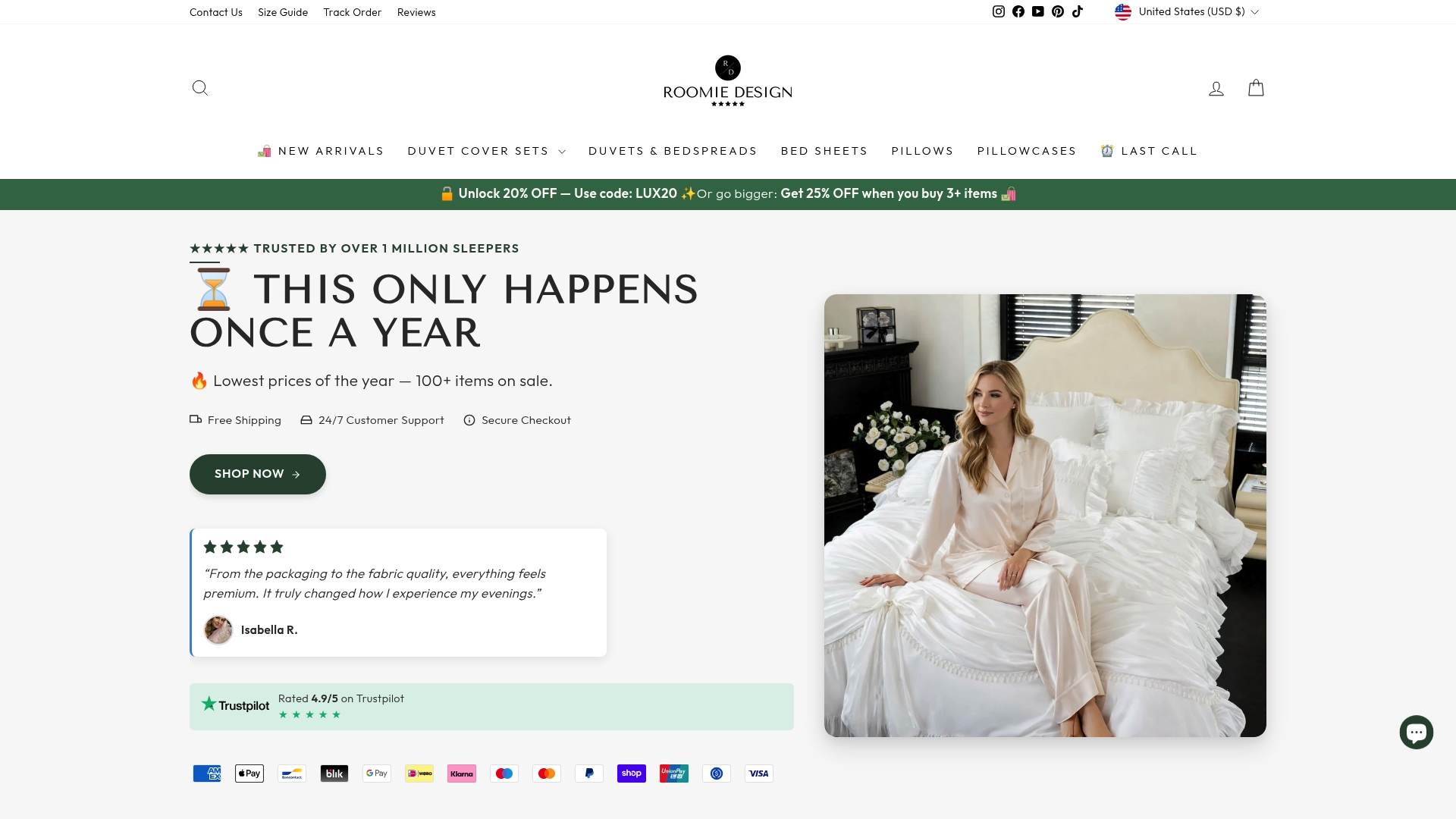
For sheets, the SkyLight Egyptian cotton 1000 TC sheet and the Soleil Luxury 1000 TC sheet offer a smooth, rich finish. For silk, see the mulberry silk bedlinen collection. Start from the Roomie Design homepage to choose your region and currency.
FAQ
Does paying in my own currency remove all fees?
Not always. Paying in your currency removes the need for you to convert, and it can help you avoid bank conversion fees. Some banks still add an international transaction fee on cards issued in a different country from the merchant. Your card terms list that fee.
Which exchange rate is used at checkout?
It depends on the setup. Platforms often use a mid-market rate based on third-party data, and some add a conversion fee in the displayed price. Stripe, for instance, lists a 2 to 4% conversion fee for its Adaptive Pricing. With display conversion, your card issuer applies its own rate when the charge posts.
What happens to a refund if the exchange rate has moved?
When you paid in your own currency, you are refunded the exact amount you paid in that currency. The seller’s side may be converted at the refund-date rate, as the platform documentation explains. If your bank did the conversion, a small difference can appear on your statement.
Why do I see different payment methods from a friend abroad?
Local payment methods depend on your country, the checkout currency, price limits and the shop’s settings. Methods such as iDEAL in euros are offered by geography and currency. Choose the option that appears for your region and keeps your currency.
How do I avoid a wrong-size return when ordering from abroad?
Check your mattress dimensions against the size guide before you add to the cart. Match duvet cover, fitted sheet and pillowcase sizes to the guide. A correct size at the start means no return and no refund conversion.
Sources
- What Is Multi-Currency Checkout?
- Optimize Your Cross-Border Ecommerce Payment Acceptance (Visa)
- Local payments: A payment localization guide (Stripe)
- How multi-currency e-commerce payments work (Stripe)
- Localize prices (Stripe Documentation)
- Multi-Currency Checkout: Who Pays FX and Refund Costs
- Cross Border Payments and Currency Guide (Global Payments)
- Setting up currencies for markets (Shopify Help Center)
- Guidelines and restrictions for selling in local currencies (Shopify Help Center)
- Using Multiple Currencies (BigCommerce)
- Local Payment Methods (Whop)
- Precio y formas de pago (Centro Europeo del Consumidor)
- Multi-Currency in Your Store (FluentCart Documentation)
- Cross-Border Payment API Integration Checklist (Antom)
- FX In E-Commerce: Multi-Currency Pricing And Payouts (Xe)


