For Baby and Sensitive Skin, OEKO-TEX vs GOTS: Which Class to Choose
OEKO-TEX tests finished textiles for harmful substances; GOTS verifies organic fibre content and the entire supply chain. For sensitive skin and baby bedding, prioritise OEKO-TEX Class I or Class II. For verified organic farming and ethical manufacturing, prioritise GOTS. For the broadest assurance available, look for both labels on the same product.
Table of Contents
- What OEKO-TEX Standard 100 covers and why it matters for sheets and pillowcases
- What GOTS certifies and why it matters for ethically made organic bedding
- Side-by-side: what each standard answers, and where they overlap
- How to choose between OEKO-TEX, GOTS, or both
- How Roomie Design approaches materials across its bedding range
- Certifications answer different questions. Neither one answers all of them
- Find your certified-conscious sheet set at Roomie Design
- Where to verify certification claims yourself
- Sources
- FAQ
What OEKO-TEX Standard 100 covers and why it matters for sheets and pillowcases
OEKO-TEX Standard 100 tests the finished product, not the farm or the factory floor. A lab checks the fabric that ends up on your bed against a published list of substances and limit values, covering things like formaldehyde, heavy metals, and banned dyes. It’s a chemical safety check on the thing you actually sleep on, which is exactly what most bedding shoppers want reassurance about.
The certification uses four product classes, and the class matters more than the label alone:
- Class I covers baby textiles and carries the strictest limit values.
- Class II covers items with direct, extended skin contact, which includes sheets and pillowcases.
- Class III covers items without direct skin contact, such as some decorative coverlets.
- Class IV covers furnishing materials like curtains.
According to OEKO-TEX’s own standard documentation, the product classes and certificate structure are laid out by Hohenstein, and certificates are typically valid for one year, requiring fresh testing to renew. When you’re checking a sheet set, look for the certificate number and the name of the test institute; both should be traceable.
Pro Tip: If a listing simply says “OEKO-TEX certified” with no product class or certificate number, ask the retailer which class applies. Class II is the relevant benchmark for sheets.
What it doesn’t cover is just as important: OEKO-TEX makes no claim about whether the cotton was grown organically, how wastewater was treated, or how workers were treated during manufacturing. It answers one question well: is this fabric safe against your skin?
What GOTS certifies and why it matters for ethically made organic bedding
GOTS (Global Organic Textile Standard) certifies the fibre and the process behind it, not just the finished sheet. It sets a minimum organic content threshold: minimum organic fibre thresholds defined for different label grades, such as a ‘made with organic’ claim and a higher threshold for a product labelled simply ‘organic’. Every stage between the cotton field and the folded sheet in your cupboard falls under the standard’s reach.
Coverage extends well beyond the fibre itself:
- Chemical inputs are restricted to an approved list, ruling out many conventional dyes and finishing agents.
- Wastewater from dyeing and finishing must meet treatment requirements before discharge.
- Social criteria are built on International Labour Organisation standards, covering fair wages, safe working conditions, and freedom from forced or child labour.
- Facilities are inspected on-site, and goods are tracked with transaction certificates from raw fibre to finished product.
This depth is why GOTS-certified organic bedding tends to carry a premium price. You are paying for verified organic fibre content, audited chemical use, and traceable labour standards, not just a soft feel. If you’re weighing up whether that difference matters to you, our guide to organic bedding walks through what “organic” actually changes in a finished sheet.
Side-by-side: what each standard answers, and where they overlap
The two standards ask different questions, which is the main source of confusion for shoppers comparing labels. OEKO-TEX asks: “Is this finished fabric free of harmful substances at the point of sale?” GOTS asks: “Was this organic fibre grown, processed, dyed, and stitched under audited environmental and labour conditions?”
- Scope: OEKO-TEX audits the finished product; GOTS audits the entire supply chain, field to shelf.
- Who it protects primarily: OEKO-TEX protects the wearer or sleeper directly; GOTS protects the wearer, the farmer, the factory worker, and the surrounding environment.
- When OEKO-TEX alone is enough: if your only concern is chemical residue against skin, a Class II certificate answers that directly.
- When GOTS is necessary: if organic farming claims, chemical wastewater treatment, or labour conditions matter to you, only GOTS covers those.
- Why some products carry both: a brand that wants to certify organic content and prove the finished fabric passes chemical safety testing will hold both labels, and industry standards overviews treat this pairing as the strongest combined assurance available.
Reading the label properly means checking for a certificate number on OEKO-TEX claims and a transaction certificate or licence number on GOTS claims, not just trusting the word “certified” printed on a swing tag.
How to choose between OEKO-TEX, GOTS, or both
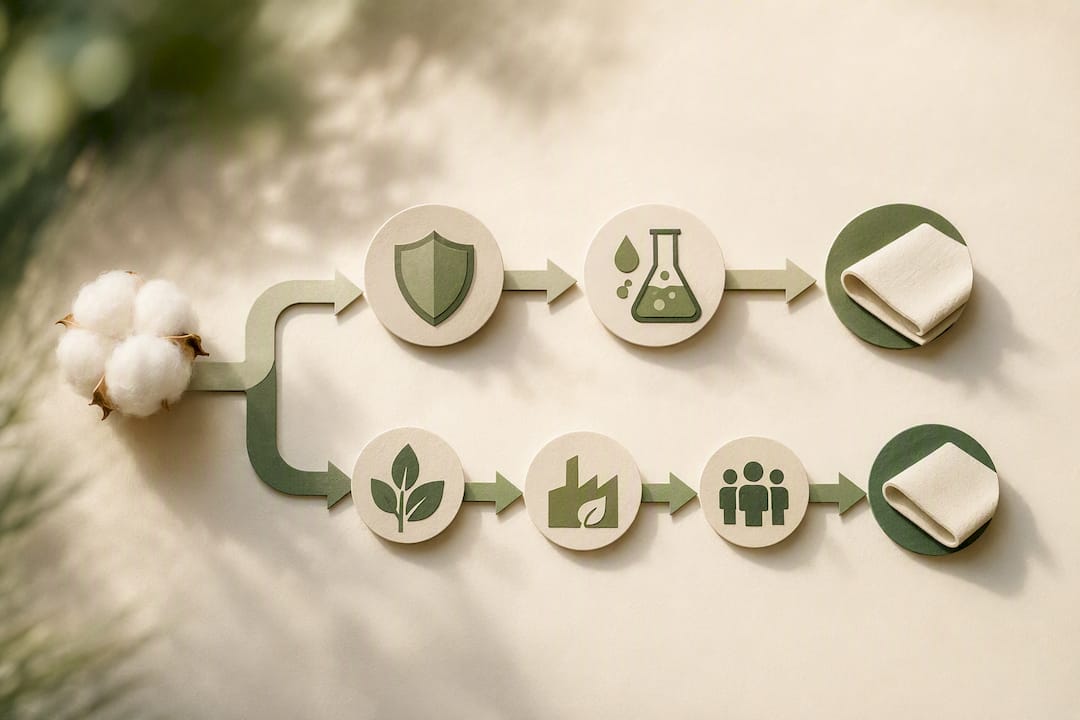
Your priority should decide which certificate you look for first, and the two priorities aren’t always the same shopper’s priorities; for insights on consumer preferences, see how interior trends bring green, eco-friendly and authenticity back.
If you’re buying for a baby’s nursery or you or a family member has sensitive skin, OEKO-TEX Class I or Class II is your first checkpoint. It directly answers the chemical safety question. Our guide on bedding for sensitive skin goes further into what else to look for beyond the label. If organic farming practices, fair labour conditions, or environmental impact drive your purchase, GOTS is the standard that actually verifies those claims rather than just implying them.
Before adding a set to your basket, run through this:
- Locate the certificate or licence number on the product page, not just the word “certified.”
- If OEKO-TEX is claimed, confirm the product class matches your use case (Class II for bedding).
- If GOTS is claimed, check whether it’s “made with organic” (70%) or “organic” (95%).
- Compare that assurance level against the price. Both labels together generally justify a higher price point than either alone.
Pro Tip: Keep a screenshot of the certificate number when you buy. If you ever need to verify it later, having the number ready saves a lot of back-and-forth with customer support.
How Roomie Design approaches materials across its bedding range
Several premium fabrics are used across bedding ranges, each with its own strengths worth understanding on the product page rather than guessing at from a swatch.
Three examples from the current range illustrate the point. The Botanical Sheet in Egyptian cotton, 500 thread count, delivers the dense, silky weight that Egyptian cotton is known for, a good fit for shoppers who want a substantial, hotel-grade feel. The Botanical Sky Blue Sheet, same fabric and thread count in a softer colourway, suits bedrooms built around calmer tones. The Bohemian Orient Sheet in Egyptian cotton brings a patterned finish to the same premium base cloth.
- Each product page carries a size guide, material specification, and customer reviews.
- Fabric details are listed clearly so you can compare thread count and weave against your own preferences.
- Shoppers wanting proof of specific claims should check the individual listing or contact support directly.
Certifications answer different questions. Neither one answers all of them
The mistake most shoppers make is treating OEKO-TEX and GOTS as competing scores on the same scale, when they’re closer to two separate exams testing entirely different subjects. A sheet can pass chemical safety testing brilliantly and still involve conventionally farmed cotton. Equally, a sheet can be rigorously organic and still need its finishing chemicals checked for skin safety, which is precisely why the two exist as separate systems rather than one combined score.
Be wary of vague sustainability language on packaging that doesn’t point to an actual certificate number. A logo alone proves nothing; a checkable licence or transaction number does. Pair that verification habit with genuine curiosity about the fabric itself, its weave, its finish, its weight, and you’ll end up making a better decision than the label alone could ever give you.
— Roomie Design
Find your certified-conscious sheet set at Roomie Design
If chemical safety or organic sourcing matters to your next bedding purchase, the smartest place to start is a product page that spells out the fabric in full rather than leaning on a single buzzword. An Egyptian cotton range is built around exactly that transparency, so you can weigh material, weight, and finish before you commit.
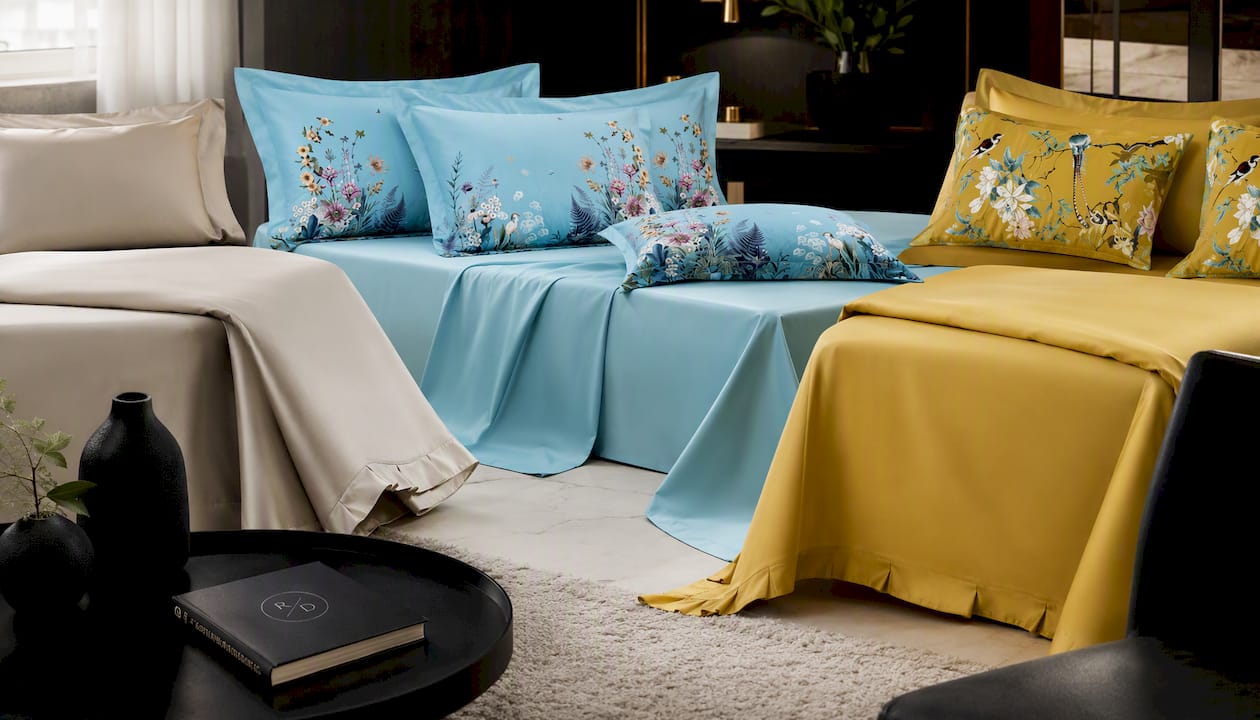
The Botanical Sheet in 500 thread count Egyptian cotton suits shoppers who want that dense, substantial hand-feel night after night, while the Botanical Sky Blue Sheet gives the same premium base cloth a softer, calmer colourway for pared-back bedrooms. If pattern is what draws you in, the Bohemian Orient Sheet carries the same Egyptian cotton quality with a more decorative finish. Each listing includes a full size guide and material specification, so open the one that fits your bedroom and check the details before you buy.
Where to verify certification claims yourself
- OEKO-TEX Standard 100 explains product classes and substance limits directly from the certifying body.
- GOTS fact sheets detail organic thresholds and supply-chain audit requirements.
- A standards comparison overview sets out how the two systems differ in scope.
Sources
- OEKO‑TEX: OEKO‑TEX Standard 100
- Hohenstein: OEKO‑TEX Standard 100 overview
- GOTS: Why GOTS helps consumers (fact sheet)
- StandardsMap: GOTS fact sheet
FAQ
Is OEKO-TEX or GOTS certification better?
Neither is inherently better; they answer different questions. OEKO-TEX confirms a finished fabric is free of harmful substances at the levels tested, while GOTS confirms the fibre is genuinely organic and the supply chain meets environmental and social standards.
Is OEKO-TEX bad for you?
No. OEKO-TEX Standard 100 exists specifically to test finished textiles against a published list of harmful substances and limit values, so a certified item has been checked for exactly the concern shoppers worry about.
Is OEKO-TEX safe for babies?
Yes, provided the product carries a Class I certificate, which sets the strictest substance limits specifically for baby textiles. Class II, used for general bedding, is not quite as strict as Class I.
Is OEKO-TEX cotton as good as organic cotton?
They’re not measuring the same thing. OEKO-TEX certified cotton has been tested for chemical safety in the finished fabric, while organic cotton under GOTS has been verified as grown without prohibited pesticides and processed under audited conditions; a fabric can hold one certification, both, or neither.


