

10 Pillow Fill Types Matched to Your Sleep Position and Care Needs
For plush, mouldable loft, choose down or a down alternative. For steady contouring, choose memory foam. For a cool, firm surface that holds its shape all night, choose buckwheat or latex. There is no single best pillow fill: the right choice depends on your sleep position, how warm you sleep, and whether allergies are a concern, and the sections below walk through each fill against support, cooling, hypoallergenic performance, care, and lifespan.
Table of Contents
- Pillow fill types at a glance
- Down versus down alternative: loft, breathability and allergies
- Memory foam pillows: solid blocks versus shredded fill
- Latex pillows: responsive support with natural cooling
- Buckwheat and microbeads: airflow, firmness and personality
- Polyester, cotton, wool and kapok: budget and natural fibre options
- Which pillow fill suits your sleep position?
- Cleaning, fluffing and knowing when to replace your pillow
- How Roomie Design chooses which pillow fills to stock
- Ready to choose your pillow? Here’s where to start
- Sources
- FAQ
Pillow fill types at a glance
Ten fills dominate the market, and each one solves a slightly different sleep problem. Rather than read every section top to bottom, use this snapshot to find your candidates first, then jump to the detail that matters to you.
- Down: Soft, compressible, high loft. Best for side and back sleepers who want a plush, moulding feel. Needs occasional fluffing and professional or gentle machine laundering.
- Down alternative: Mimics down’s softness with synthetic clusters. Best for allergy-conscious shoppers who still want that sink-in feel. Machine-washable, which makes upkeep simple.
- Solid memory foam: Dense, contouring, steady. Best for back and side sleepers needing consistent neck support. Spot-clean only; the block itself cannot go through a washing machine.
- Shredded memory foam: Mouldable and adjustable. Best for combination sleepers who shift positions overnight. Often has a removable, washable cover with fill you can top up.
- Latex: Responsive and naturally breathable. Best for back and side sleepers wanting bounce rather than sink. Wipe-clean cover only; the core stays dry.
- Buckwheat: Firm, heavy, extremely airy. Best for hot sleepers and anyone who likes a fully adjustable, chunky feel. Hulls can be topped up for years.
- Microbeads: Light, squishy, novelty-grade support. Best for travel pillows and decorative cushions rather than nightly sleep.
- Polyester fibrefill: Budget-friendly and washable. Best for guest rooms or those replacing pillows often. Flattens faster than most other fills.
- Cotton: Breathable and natural. Best for sleepers who prefer plant-based fills. Tends to compress and needs regular fluffing.
- Wool: Insulating and moisture-wicking. Best for sleepers who run cold or sweat overnight. Airs out well but should not be soaked.
- Kapok: Silky and down-like without feathers. Best for sleepers wanting a natural fill with a soft hand. Loses loft faster than down and needs frequent fluffing.
Once you’ve spotted one or two candidates, read on for the trade-offs that actually matter when you’re the one sleeping on it.
Down versus down alternative: loft, breathability and allergies
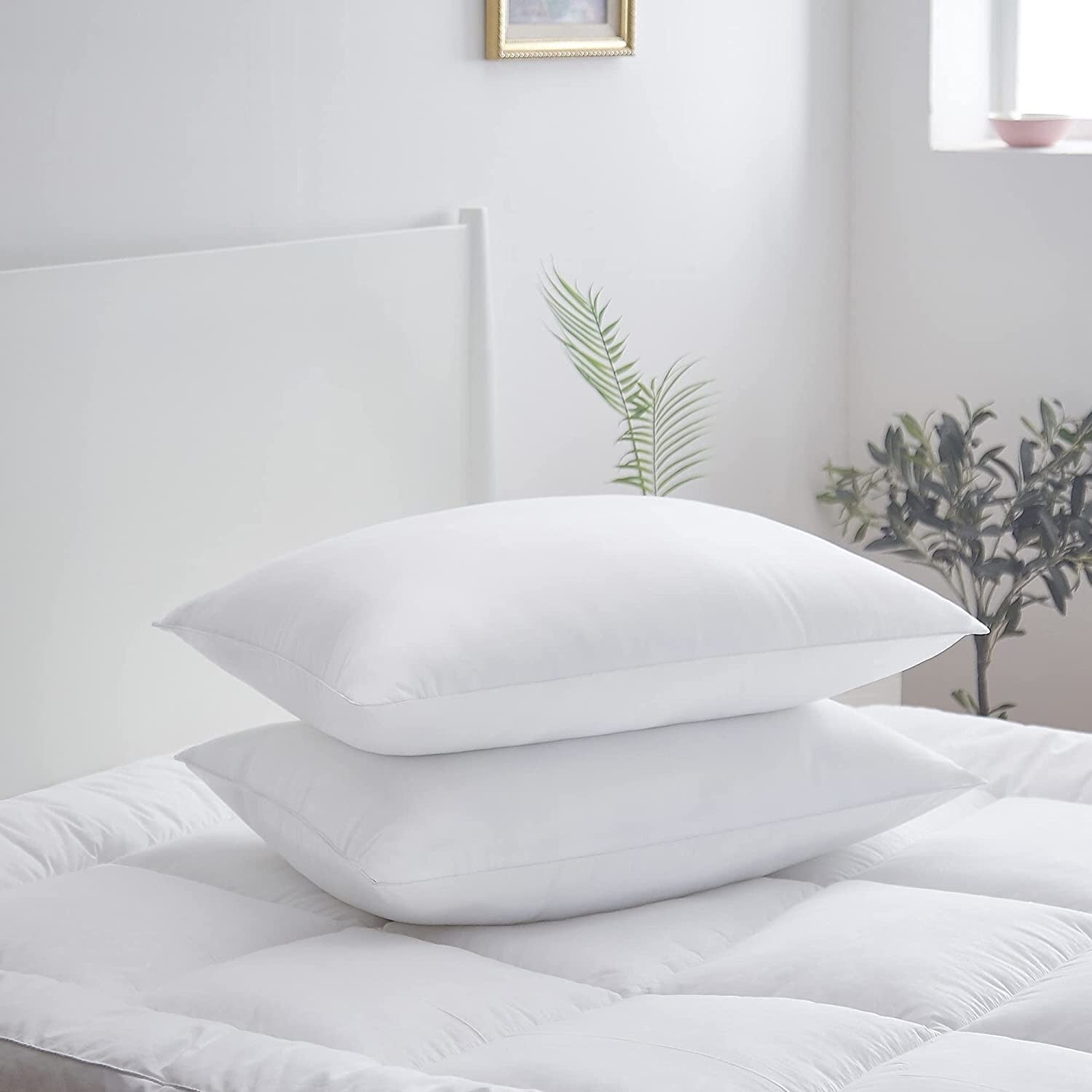
Down is the soft undercoating found beneath a bird’s feathers, distinct from feathers themselves, and it’s prized because it traps air far more efficiently than most synthetic fibres, giving pillows their signature cloud-like loft, as Canadian Down & Feather explains. Higher fill power (the volume one ounce of down occupies) means more loft per gram and a longer working life before the clusters compress. A well-made down pillow can outlast several cheaper alternatives, which is part of why premium bedding brands treat it as a long-term investment rather than a disposable comfort item.
Down alternative pillows use engineered synthetic clusters designed to replicate that same soft, moulding feel. The gap between the two has narrowed considerably: modern synthetics increasingly match down’s hand-feel while offering easier machine-washable care. For allergy-sensitive sleepers, that distinction matters more than loft. High-quality down alternatives are engineered specifically to avoid animal-derived allergens while still delivering a plush sleep surface, which is why they’re frequently recommended for hypoallergenic sleep setups.
- Down: superior loft-to-weight ratio, longer lifespan, needs gentle laundering or professional cleaning.
- Down alternative: near-identical softness, fully machine-washable, generally the easier everyday choice.
- Allergy-prone sleepers: down alternative removes animal-protein exposure without sacrificing the plush feel.
Pro Tip: Fluff your down or down-alternative pillow by hand every morning. It redistributes the clusters and keeps the loft looking full for years rather than months.
Memory foam pillows: solid blocks versus shredded fill
Solid memory foam is a single moulded block that gives consistent, unmoving support, which is exactly why it’s a favourite for spinal alignment among back and side sleepers. It holds its shape through the night with no shifting, but that density can trap warmth, so many solid-foam pillows now come with cooling gel layers or perforated, breathable covers to offset the effect.
Shredded memory foam takes the same contouring material and breaks it into moveable pieces, letting the pillow mould around your head and neck rather than holding one fixed shape. Shredded fills are often housed in zippered covers that let you add or remove material, so you can dial in loft and firmness yourself, a genuinely useful feature for combination sleepers or couples with different preferences sharing a bed.
- Solid foam: best for back and side sleepers who want zero movement overnight.
- Shredded foam: best for combination sleepers and anyone wanting adjustable loft.
- Stomach sleepers: usually better served by a low-loft alternative than either foam format, since too much height strains the neck.
Between the two, shredded memory foam tends to run cooler and adapt more readily than a solid block, simply because air can move through the gaps between pieces rather than being trapped in one dense mass.
Latex pillows: responsive support with natural cooling
Latex behaves differently from foam because it springs back rather than slowly conforming, giving a buoyant, cushioned feel that many back and side sleepers prefer over the slower sink of memory foam. You’ll find three variants on the market: natural latex tapped from rubber trees, synthetic latex made from petrochemicals, and blended latex combining both. Within natural latex, Dunlop processing produces a denser, firmer feel, while Talalay processing creates a lighter, more aerated structure.
That aeration is also why latex performs well for temperature regulation compared with solid foam: its open-cell structure allows continuous airflow rather than holding heat close to the head. Latex is naturally resistant to dust mites too, adding a practical hypoallergenic edge.
- Feel: responsive and bouncy rather than slow-moulding.
- Best for: back and side sleepers wanting support without excessive sink.
- Care: wipe the cover clean; the latex core itself should never go in a washing machine.
- Lifespan: among the longer-lasting fills when kept dry and out of direct sunlight.
Buckwheat and microbeads: airflow, firmness and personality
Buckwheat hull pillows are the firmest, heaviest option on this list, and that weight is precisely what gives them their reputation among hot sleepers: air moves freely between the hulls, keeping the surface cool through the night. They’re also fully adjustable since hulls can be added or removed to change height, and with proper care, buckwheat pillows can last ten to twenty years, often outliving every other fill on this list.
The trade-off is sensory: hulls shift and rustle with movement, and the density means these pillows are considerably heavier than a down or foam equivalent. Sleepers who dislike noise or want something they can toss around easily will likely find microbeads a gentler introduction to firm, airy support.
- Microbeads: tiny polystyrene spheres that flex around pressure points, common in travel and support cushions.
- Best for: hot sleepers (buckwheat) and those wanting light, squishy support without full firmness (microbeads).
- Trade-off: buckwheat’s rustle and weight versus microbeads’ lower durability for nightly, full-size use.
Polyester, cotton, wool and kapok: budget and natural fibre options
Polyester fibrefill is the fill you’ll meet most often at entry-level price points, and it earns that spot honestly: it’s inexpensive, fully machine-washable, and easy to replace. The catch is speed of wear. Fibrefill tends to clump and lose shape within three to six months of nightly use, which makes it better suited to guest rooms or frequent replacement than a primary pillow you’ll keep for years.
Cotton fill appeals to sleepers who specifically want a plant-based, breathable material. It handles moisture well and feels crisp rather than plush, though it compresses faster than down or latex and needs regular fluffing to stay lofted.
Wool sits in an interesting middle ground: it wicks moisture away from the head while insulating against temperature swings, which makes it a strong pick for people who run cold at night or sweat through synthetic fills. It airs out naturally between uses rather than needing frequent washing.
Kapok, the silky fibre from the kapok tree’s seed pods, gives a down-like softness without any animal product involved. It’s prized for its light, airy hand, though it loses loft faster than down and needs more frequent fluffing to stay full.
- Polyester: cheapest, washable, shortest lifespan of the group.
- Cotton: breathable and natural, but flattens without regular fluffing.
- Wool: excellent temperature regulation, minimal washing needed.
- Kapok: down-like feel without feathers, but softer loft retention.
Pro Tip: If you like the idea of a natural fibre but want it to last, pair it with a supportive base layer, like a firmer pillow underneath, rather than relying on the natural fill alone for structure.
Which pillow fill suits your sleep position?
- Side sleepers need higher loft and firmer support to keep the neck aligned with the spine, which points towards down, latex, or a firmer shredded memory foam.
- Back sleepers generally do best with medium loft and medium support. Down, latex, and solid memory foam all work well here, since they cradle the head without pushing it too far forward.
- Stomach sleepers need the opposite: low loft and a soft, compressible fill. A soft down pillow, a thin polyester fill, or a low-loft down alternative all keep the neck closer to a neutral position.
- Combination sleepers benefit most from adjustable fills, particularly shredded memory foam or buckwheat, since both let you reshape loft as you shift positions overnight.
- Hot sleepers should prioritise buckwheat, latex, or high-quality down over solid memory foam, which retains more warmth against the head.
- Allergy-sensitive sleepers are best served by natural latex, wool, kapok, or a well-made down alternative, all of which sidestep the animal-protein triggers that come with traditional down.
There genuinely isn’t one universal answer here. Sleep position drives the recommendation more than any other factor, so match the fill to how you actually sleep rather than to whichever pillow looks most luxurious in a photograph.
Cleaning, fluffing and knowing when to replace your pillow
Care routines differ sharply by fill, and getting this wrong is the fastest way to shorten a pillow’s life. Down and down alternative pillows generally tolerate gentle machine washing on a low, cold cycle, followed by thorough tumble drying with a few clean tennis balls to keep clusters separated. Latex and solid memory foam should never go in a washing machine; wipe the outer cover and leave the core to air dry if it ever gets damp. Buckwheat hulls can be sun-aired but not washed, while polyester, cotton, and wool covers usually handle a standard gentle wash cycle without issue.
- Loss of loft that fluffing no longer fixes signals it’s time to replace or top up the fill.
- A persistent odour that survives washing usually means moisture has reached the core, not just the cover.
- Flattened, lumpy support that no longer bounces back is the clearest sign a fill has reached the end of its useful life.
Regular fluffing, appropriate laundering, and timely replacement preserve comfort far more reliably than buying a new pillow every time one loses its shape. For allergy-sensitive households, the CDC lists bedding dust mites among common asthma triggers, so washing pillowcases weekly and choosing a hypoallergenic fill both do real, measurable work in reducing exposure.
How Roomie Design chooses which pillow fills to stock
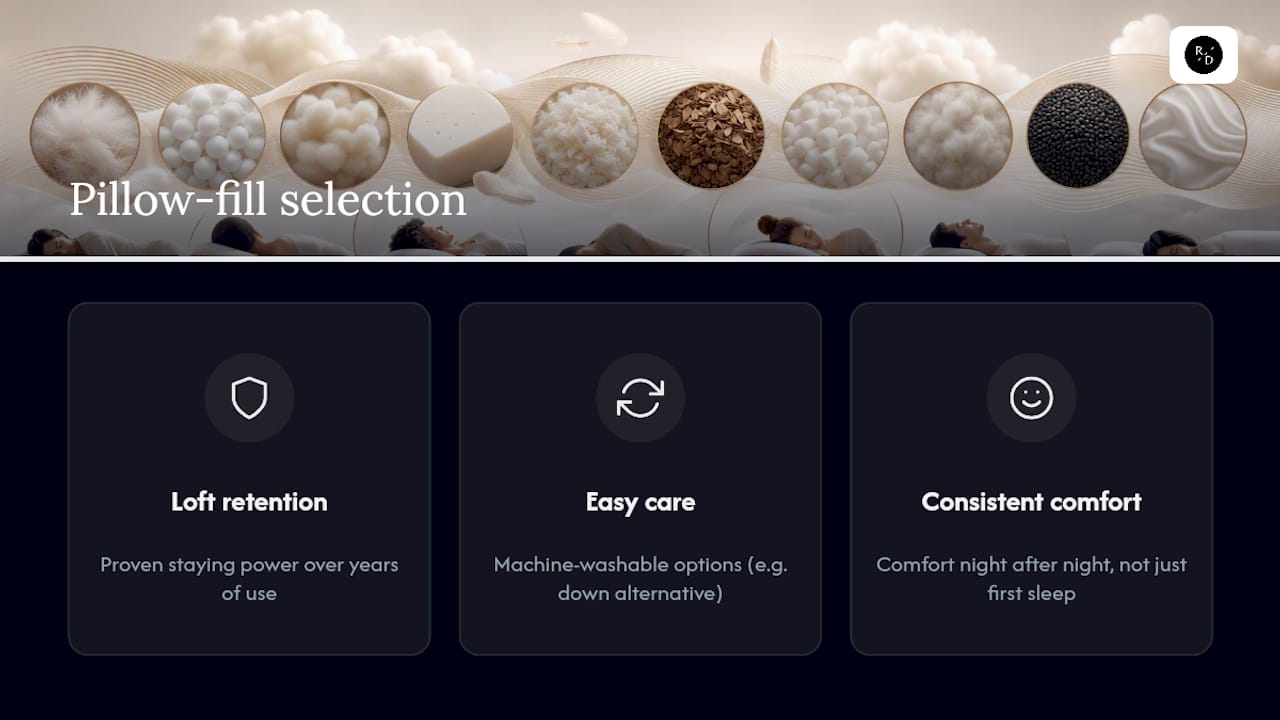
Roomie Design selects fills against three practical measures: how well the material holds its loft over years of use, how easy it is to care for at home, and how consistently comfortable it feels night after night, not just on the first sleep. That filter is why the range leans towards fills with proven staying power rather than novelty materials.
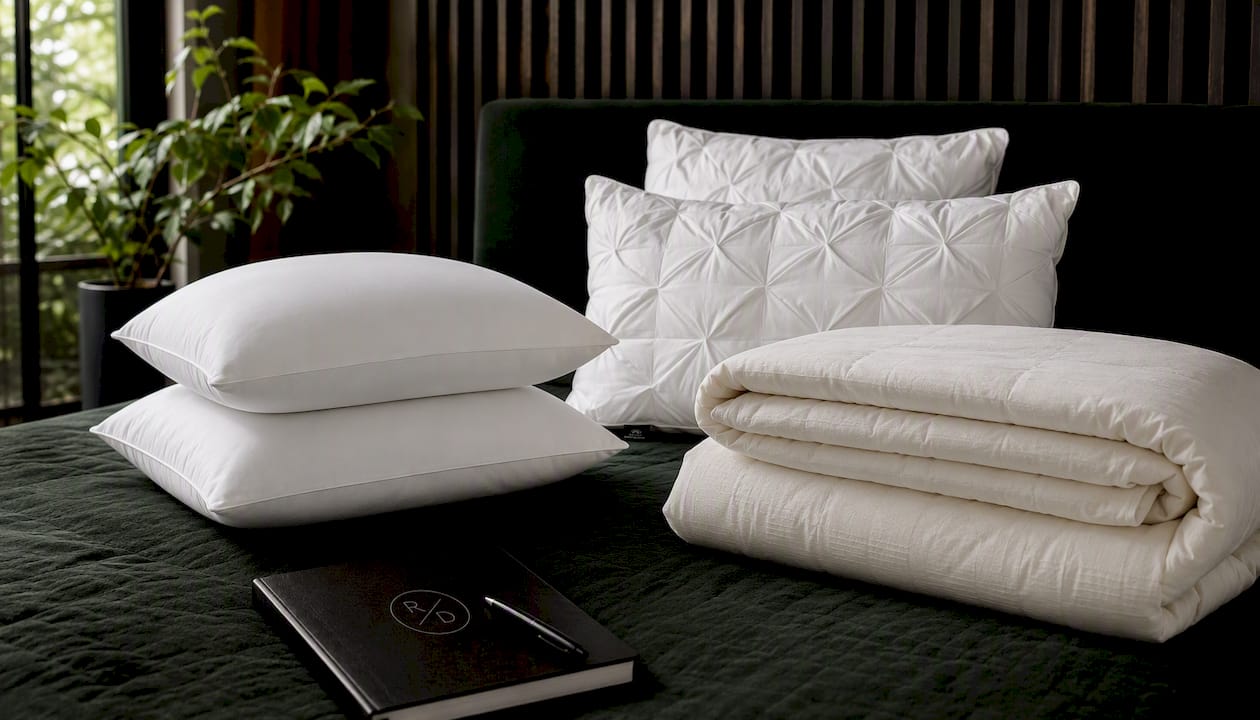
For allergy-conscious sleepers or anyone wanting effortless machine-washable care, the Hypo-allergenic Down Alternative Pillows (Set of 2) deliver that plush, down-like sink without the upkeep of natural down. For sleepers chasing the classic luxury hotel feel, the Minimalist Down & Feather Pillow (Set of 2) pairs down’s softness with feather’s supportive resilience. And for those building out a full bedding set around a similar fill philosophy, the Cloud-Like Cotton & Microfiber Down Alternative Duvet extends the same cotton-and-microfiber comfort logic to the whole bed.
— Roomie Design
Ready to choose your pillow? Here’s where to start
If you read the sleeper-position guide above and landed on “plush but easy to wash,” the Hypo-allergenic Down Alternative Pillows (Set of 2) are the straightforward next step. If you want that classic hotel-grade loft with feather’s added resilience underneath, the Minimalist Down & Feather Pillow (Set of 2) delivers exactly that combination.
Before you buy, confirm your size against a standard versus queen pillow size guide, check the care label for wash instructions specific to your chosen fill, and consider buying pillows as a set so both sides of the bed feel identical night after night. Shoppers wanting to explore how these fills sit within a full bedroom refresh can also browse the premium bedding materials guide for background on fabric pairings before checkout. Whichever fill you’ve settled on, add your chosen pillows to your basket and complete your order today to start sleeping on the right support tonight.
Sources
- What’s the difference between down and feather? | Canadian Down & Feather
- Asthma triggers | Centers for Disease Control and Prevention (CDC)
FAQ
What kind of filling is best for pillows?
There’s no single best fill: down and latex suit those wanting plush, responsive support, memory foam suits contouring needs, and buckwheat suits hot sleepers wanting maximum airflow.
What is the healthiest type of pillow filling?
Natural latex, wool, and kapok are commonly recommended for allergy-sensitive sleepers, alongside high-quality down alternatives engineered to avoid animal-derived allergens, such as Roomie Design’s Hypo-allergenic Down Alternative Pillows (Set of 2).
What are most hotel pillows filled with?
Many hotels favour down or down and feather blends for their plush, luxurious feel, alongside high-quality down alternatives that offer similar softness with easier laundering between guests.
What is the coolest pillow filling?
Buckwheat hulls, natural latex, and high-quality down generally offer the best natural airflow, while shredded memory foam sleeps noticeably cooler than a solid foam block.


