
Comment styliser la literie pour une chambre à coucher luxueuse
TL;DR :
- Agencer un lit implique de superposer des draps de base avec des éléments décoratifs pour créer un look raffiné et reposant. L'utilisation de couches minimales et coordonnées et de tissus de qualité assure une chambre élégante et pratique, facile à entretenir au quotidien. Un style excessif avec trop de coussins ou des textures dépareillées peut nuire au confort et à l'attrait visuel.
Se réveiller dans une chambre qui n'a jamais tout à fait l'air ou la sensation voulue est une frustration courante. Le lit est la pièce maîtresse de la pièce, mais de nombreux propriétaires ont du mal à le rendre impeccable sans savoir par où commencer. La bonne nouvelle est que le style de la literie est simple une fois que vous avez compris les principes de base. Ce guide couvre tout, des couches fondamentales aux choix de couleurs de finition, afin que vous puissiez créer un lit reposant et bien habillé sans devinettes ni efforts inutiles.
Points clés à retenir
| Point | Détails |
|---|---|
| L'importance des fondations | Commencez chaque projet de style de lit avec des draps-housses et des draps plats pour un confort et une propreté durables. |
| Superposez avec soin | Composez votre literie avec des couches coordonnées pour la chaleur, la texture et un look de designer. |
| Moins, c'est plus | Évitez de surcharger avec trop d'oreillers ou d'accessoires pour un résultat raffiné et accessible. |
| La cohésion sublime le style | Choisissez une palette de couleurs unifiée et variez les textures pour une chambre sophistiquée et luxueuse. |
| Élégance fonctionnelle | Optez pour des matériaux et des arrangements pratiques, faciles à entretenir au quotidien. |
Préparer le style de votre literie : ce dont vous avez besoin et les essentiels
Avant d'arranger un seul oreiller, il est utile de savoir exactement avec quoi vous travaillez. Le style de la literie commence par les fondations et se construit vers le haut, de sorte que rassembler les bonnes pièces à l'avance permet de gagner du temps et de produire un résultat plus cohérent.
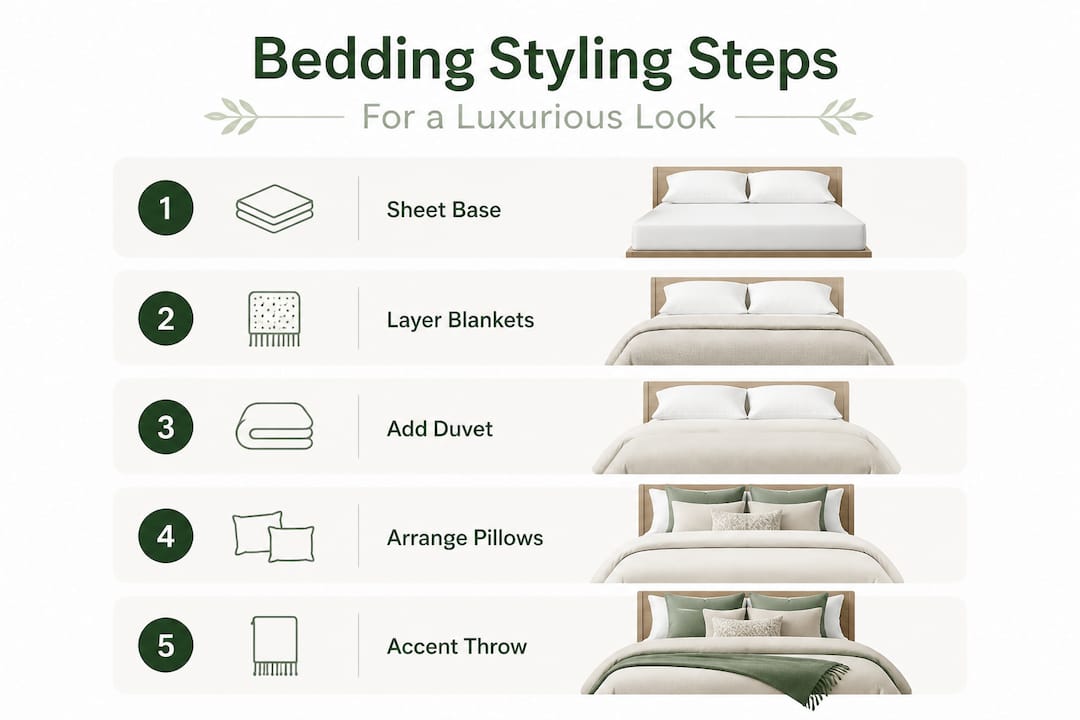
Selon The Spruce, la bonne approche consiste à commencer par les draps-housses, ajouter un drap plat ou drap du dessus facultatif, puis ajouter de la chaleur et de la texture avec un couvre-lit ou une courtepointe, suivi d'une couette ou d'un édredon, et terminer avec un jeté au pied du lit ainsi qu'un arrangement d'oreillers superposés. Cette séquence s'applique que vous prépariez un lit simple ou un très grand lit.
Voici un aperçu clair des couches principales et de leur but :
| Couche | Article | But |
|---|---|---|
| Fondation | Drap-housse | Confort de base, garde le matelas propre |
| Optionnel | Drap plat/du dessus | Douceur supplémentaire, lavage facile |
| Couche intermédiaire | Couvre-lit ou courtepointe | Chaleur légère, texture visuelle |
| Chaleur principale | Couette ou édredon | Isolation primaire |
| Accent | Jeté | Texture et couleur au pied du lit |
| Oreillers | De couchage + décoratifs | Fonction et structure visuelle |
Les matériaux et les textures sont également importants. Le coton, le lin, le lyocell et la soie créent tous des effets visuels distincts.
- Coton : Net, respirant et facile d'entretien. Convient à un look classique ou minimaliste.
- Lin : Décontracté et légèrement texturé. S'harmonise bien avec les styles ferme et côtier.
- Lyocell/bambou : Lisse avec un léger éclat. Ajoute un luxe subtil sans formalité.
- Soie : Très brillante et spectaculaire. Mieux utilisée comme une seule couche d'accent plutôt que partout.
Coordonner les matériaux ne signifie pas que tout doit correspondre exactement. L'objectif est un poids visuel cohérent. Mélanger le lin avec le coton, par exemple, donne une impression décontractée et réfléchie. Notre guide de superposition de literie couvre plus en détail les combinaisons de tissus si vous souhaitez explorer des associations spécifiques.
Superposition pas à pas : créer confort et attrait visuel
Avec les éléments essentiels en main, il est temps de les assembler de manière à la fois élégante et pratique. Suivre un ordre clair élimine les incertitudes et produit un résultat intentionnel à chaque fois.
- Posez le drap-housse. Tirez le drap-housse en le lissant et rentrez tout le mou sous les coins du matelas. Une base sans plis aligne mieux tout ce qui se trouve au-dessus.
- Ajoutez un drap plat (facultatif). Placez-le côté lisse vers le bas afin que l'ourlet décoratif soit visible et se replie sur la couette plus tard. Ce détail donne au lit une finition digne d'un hôtel.
- Posez le couvre-lit ou la courtepointe. Positionnez-le de manière à ce qu'il pende uniformément des deux côtés. Cette couche intermédiaire ajoute de la profondeur et est particulièrement utile pendant les mois plus chauds lorsque une couette complète est trop lourde.
- Positionnez la couette ou l'édredon. Pliez le bord supérieur d'environ 30 cm pour révéler le drap plat ou le couvre-lit en dessous. Ce pli crée de la structure et met en valeur les couches.
- Placez le jeté. Pliez-le de manière décontractée ou en un pli droit au pied du lit. Un jeté ajoute la couche de chaleur finale et un point de contraste de couleur ou de texture.
- Arrangez les oreillers de couchage en premier. Placez deux ou trois oreillers droits contre la tête de lit dans leurs taies. Ils forment la rangée arrière et la base pratique de l'arrangement.
- Ajoutez des coussins décoratifs devant. Placez un à trois coussins devant les oreillers de couchage, en variant la taille du plus grand à l'arrière au plus petit à l'avant.
Conseil de pro : Si vous utilisez une housse de couette avec un nombre de fils élevé lavable en machine, vous pouvez ignorer le drap plat entièrement. La designer d'intérieur Emily Henderson note que le drap plat n'est pas nécessaire lorsque la housse de couette est facile à laver, bien qu'il reste utile si vous préférez un système d'édredon non lavable.
Pour plus d'inspiration sur les combinaisons de couleurs et de motifs à chaque couche, la collection d'idées de design de literie offre une référence visuelle pratique.
Une comparaison rapide des deux principales approches de style :
| Approche | Couches utilisées | Convient le mieux pour |
|---|---|---|
| Style d'hôtel minimaliste | Drap-housse, housse de couette, deux oreillers | Utilisation quotidienne facile, esthétique épurée |
| Style entièrement superposé | Toutes les couches, y compris la courtepointe, le jeté et plusieurs coussins | Look luxueux, climats plus froids |
Éviter les erreurs courantes : pourquoi moins, c'est souvent plus
Après avoir appris les bases, il est crucial de comprendre ce qu'il ne faut pas faire pour un look impeccablement raffiné. Le sur-stylisme est l'un des pièges les plus courants, et il nuit à la fois à la praticité et à l'attrait visuel.
« Utilisez une superposition sobre, respirante, de type hôtel : évitez de trop mettre en scène avec trop d'éléments décoratifs ; un plus petit nombre d'oreillers a souvent meilleur aspect et est plus facile à utiliser au quotidien. » Vogue
Les erreurs les plus fréquentes à éviter :
- Trop de coussins. Plus de trois coussins décoratifs sur un lit double frise rapidement l'encombrement. Les lits trop habillés créent un inconvénient quotidien car il faut complètement déconstruire l'arrangement juste pour se coucher et se lever. Les contributeurs de Vogue mettent spécifiquement en garde contre le style trop chargé en coussins.
- Textures dépareillées sans fil conducteur. Combiner cinq types de tissus différents sans une couleur ou un poids unifiant crée un bruit visuel plutôt que de l'intérêt.
- Ignorer l'échelle. Des coussins surdimensionnés sur un lit simple ou de minuscules coussins décoratifs sur un très grand lit semblent disproportionnés.
- Oublier le pli. Poser la couette à plat sans replier le bord supérieur donne au lit un aspect plat et inachevé.
Conseil de pro : Traitez votre lit comme une chambre d'hôtel. Les lits les plus élégants que vous voyez dans les hôtels utilisent très peu d'éléments, tous bien repassés et coordonnés. Si vous passez plus de trois minutes à enlever des coussins chaque soir, vous êtes probablement allé trop loin. Lisez-en davantage sur le choix de la literie pour le confort afin de trouver le bon équilibre entre style et praticité. Il est également utile de comprendre ce qui distingue la literie de créateur de la literie standard lorsque vous investissez dans des pièces clés.
Touches finales : palettes de couleurs, textures et détails coordonnés
Une fois la base et les couches en place, les détails finaux élèvent une chambre de l'ordinaire à l'invitant. Le choix des couleurs est l'endroit où beaucoup de gens harmonisent une pièce ou, par inadvertance, créent un résultat dérangeant.
House Beautiful et Vogue soulignent tous deux que les lits ont une sensation de luxe lorsque les couches sont coordonnées, et non chaotiques. L'approche la plus efficace consiste à choisir une palette tonale de deux ou trois nuances apparentées, puis à introduire un accent par le biais d'un seul coussin ou d'un jeté.
Principes clés de couleur et de texture :
- Les neutres tonals fonctionnent universellement. Les blancs doux, les crèmes chauds et les gris pâles créent une toile de fond reposante qui convient à la plupart des styles de pièces et est facile à mettre à jour saisonnièrement.
- Un seul accent est suffisant. Un seul coussin à motif audacieux, ou un jeté dans une couleur contrastante, apporte un intérêt visuel sans perturber le calme général.
- Variez la texture au sein d'une même couleur. L'utilisation de coton, de lin et d'un jeté tissé, le tout dans la même teinte, crée une profondeur subtile. Cela donne une impression sophistiquée plutôt que "trop assorti".
- Évitez plus d'une pièce à motifs. Si la housse de couette présente un motif, gardez les coussins et les jetés dans des couleurs unies ou des tissages subtils.
Statistique à noter : Les enquêtes auprès des professionnels du design d'intérieur montrent constamment que les chambres les plus apaisantes n'utilisent pas plus de trois couleurs dans le schéma principal, la texture fournissant la variation plutôt que le motif.
Notre point de vue : pourquoi le style de la literie est autant une question de fonction que de forme
Il existe une idée reçue selon laquelle un beau lit est un lit qui demande des efforts chaque matin. Après avoir travaillé avec une large gamme de matériaux et de styles de literie, la réalité indique le contraire.
Les lits qui sont les plus beaux jour après jour sont ceux qui sont simples à entretenir. Les housses de couette lavables en coton durable ou en lyocell garantissent que l'ensemble du système reste frais avec un minimum d'effort. Limiter les coussins décoratifs à deux ou trois signifie que le lit est prêt en moins d'une minute. Choisir une literie améliorée qui privilégie la qualité des matériaux plutôt que la quantité de pièces donne constamment de meilleurs résultats.
Le luxe en matière de literie ne réside pas dans le nombre de couches ni dans la complexité de l'arrangement. Il vient de la qualité d'une seule housse de couette bien choisie, du toucher d'un drap de coton à nombre de fils élevé et de la satisfaction visuelle d'une palette coordonnée qui ne nécessite aucun ajustement quotidien. Une exécution simple et élégante l'emporte toujours sur les arrangements complexes.
Transformez votre chambre avec de la literie de designer
Si vous êtes prêt à appliquer ces principes, les collections sélectionnées de Roomie Design simplifient la prochaine étape.
Roomie Design propose des parures de lit coordonnées dans une gamme de tissus haut de gamme, de nombres de fils et de palettes de couleurs. L'ensemble de literie de luxe jacquard oriental rouge offre un luxe de 600 fils avec des détails audacieux et coordonnés. Pour un look plus chaleureux et raffiné, la literie de luxe Aristocrat Gold associe des tons riches à une finition haut de gamme. Vous préférez un style épuré, inspiré des hôtels ? La parure de couette Hotel Luxe apporte le détail de bordure contrastée et la simplicité raffinée d'une chambre cinq étoiles directement dans votre chambre. Tous les ensembles sont disponibles en plusieurs tailles avec des spécifications complètes pour vous guider dans votre choix.
Questions fréquemment posées
Ai-je vraiment besoin d'un drap plat si ma housse de couette est lavable ?
Non, un drap plat n'est pas essentiel si votre housse de couette est facile à laver. Comme le souligne Emily Henderson, c'est un choix pratique plutôt qu'une exigence de style, même si cela peut ajouter du confort dans certaines configurations.
Combien d'oreillers conviennent le mieux à un lit double ?
Un lit double peut accueillir deux oreillers de couchage et un ou deux coussins décoratifs. Garder la disposition simple est plus esthétique et rend l'utilisation quotidienne beaucoup plus facile.
Quelle est la manière la plus simple de donner un aspect luxueux à la literie ?
Choisissez une palette de couleurs cohérente et variez les textures comme le coton, la soie ou le lin. Des couches coordonnées sans motifs dépareillés créent de la profondeur et un résultat raffiné avec un minimum d'effort.
Comment puis-je conserver un style fonctionnel pour une utilisation quotidienne ?
Sélectionnez des tissus faciles d'entretien et limitez les coussins décoratifs à deux ou trois. Les lits avec des coussins excessifs deviennent un inconvénient quotidien qui décourage rapidement un style cohérent.
Recommandé
- Les meilleures idées de design de literie pour transformer votre chambre – Roomie Design
- Comment choisir la literie pour un confort et un style élégants à la maison – Roomie Design
- Le guide ultime de superposition de literie pour le confort et le style – Roomie Design
- Ce qui distingue la literie de designer : qualité vs ensembles standard – Roomie Design
- Qu'est-ce que la décoration intérieure de luxe et pourquoi elle compte – Marmorique


